


Page 24 - BBC Wildlife Volume 36 #05
P. 24
CHEETAHS


                                    fter six months working for the Cheetah   Society of London, myself and numerous others. It’s the
                                    Conservation Fund in Namibia, I still   first comprehensive overview of more than 45 years of
                                    hadn’t seen a cheetah. Such is life as a   research on cheetahs.
                                    professional ecologist sometimes; it’s not   One long-held theory for why young cheetahs like
                                    as if we spend the entire time witnessing   Hifi and Sam band together is that it might improve
                                    dramatic scenes like in the BBC’s Big Cats   their hunting success. Solitary cheetahs prefer small- to
                                    or Planet Earth II. Then one night I was   medium-sized antelopes such as impala, springbok and
                         Awalking home when something came into        gazelles. They also hunt warthogs, hares and birds like
                         view on the dusty track ahead. A cheetah! I recognised   guinea fowl. By contrast, adolescent cheetahs in groups
                         him – Hifi. He had long been inseparable from his   can in addition target larger prey, such as kudu calves,
                         brother Sam, who had died a few years earlier.  which they would not be able to catch by themselves.
                           Hang on… aren’t cheetahs, indeed pretty much all wild   Each group member still eats the same amount of meat
                         cats apart from lions, famous for being solitary? What were   as they would do if living alone, however. In other words, it
                         these brothers doing living together? Well, it’s a little-known   can’t be hunting success alone that drives young cheetahs to
                         fact that lions aren’t the only social cats. Together with the   stay together. There must be another reason.
                         usual interactions cats have, such as a mother bringing
                         up cubs or a male and female coming together to mate,   SAFETY IN NUMBERS
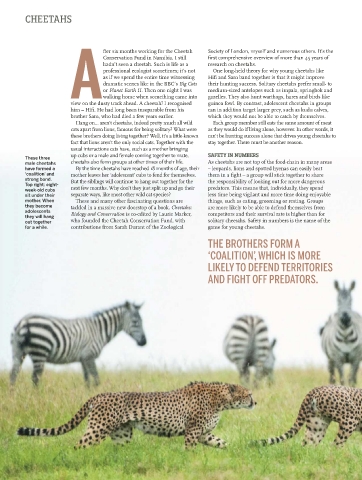
          These three
          male cheetahs   cheetahs also form groups at other times of their life.  As cheetahs are not top of the food-chain in many areas
          have formed a    By the time cheetahs have reached 18 months of age, their   – leopards, lions and spotted hyenas can easily beat
          ‘coalition’ and   mother leaves her ‘adolescent’ cubs to fend for themselves.   them in a fight – a group will stick together to share
          strong bond.   But the siblings will continue to hang out together for the   the responsibility of looking out for more dangerous
          Top right: eight-
          week-old cubs   next few months. Why don’t they just split up and go their   predators. This means that, individually, they spend
          sit under their   separate ways, like most other wild cat species?  less time being vigilant and more time doing enjoyable
          mother. When     These and many other fascinating questions are   things, such as eating, grooming or resting. Groups
          they become    tackled in a massive new doorstop of a book. Cheetahs:   are more likely to be able to defend themselves from
          adolescents
          they will hang   Biology and Conservation is co-edited by Laurie Marker,   competitors and their survival rate is higher than for
          out together   who founded the Cheetah Conservation Fund, with   solitary cheetahs. Safety in numbers is the name of the
          for a while.   contributions from Sarah Durant of the Zoological   game for young cheetahs.
                                                                       THE BROTHERS FORM A

                                                                       ‘COALITION’, WHICH IS MORE

                                                                       LIKELY TO DEFEND TERRITORIES
                                                                       AND FIGHT OFF PREDATORS.

