


Page 25 - BBC Wildlife Volume 36 #05
P. 25
But it seems there’s an unequal balance when living
          with siblings, which depends on gender. “On the face of
          it, adolescent males gain most by pairing up with their
          sisters,” says Sarah Durant. This is because they rely on
          their sisters to do more of the hunting. “On the other
          hand, there appears to be no overall benefits or costs to
          females pairing up with their brothers,” she continues.
          It could be that, while it is more dangerous to do most
          of the hunting, the females compensate for this with the
          extra protection they get from their brothers.
           Once female cheetahs become fertile, generally at 18–
          24 months old, they break apart from the group to live on
          their own. This leaves the brothers to form a ‘coalition’,
          which is a bit like a bachelor pride of male lions.
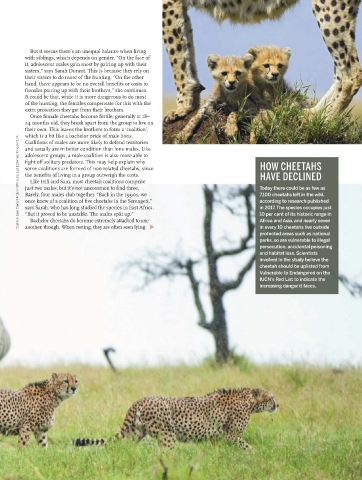
       Coalition: Sean Crane/Minden/FLPA; cubs: Suzi Eszterhas/Minden/FLPA  fight off solitary predators. This may help explain why   Today there could be as few as
          Coalitions of males are more likely to defend territories
          and usually are in better condition than lone males. Like
          adolescent groups, a male coalition is also more able to
                                                                                         HOW CHEETAHS
          some coalitions are formed of non-related cheetahs, since
                                                                                         HAVE DECLINED
          the benefits of living in a group outweigh the costs.
           Like Hifi and Sam, most cheetah coalitions comprise
          just two males, but it’s not uncommon to find three.
                                                                                         7,100 cheetahs left in the wild,
          Rarely, four males club together. “Back in the 1990s, we
                                                                                         according to research published
          once knew of a coalition of five cheetahs in the Serengeti,”
                                                                                         in 2017. The species occupies just
          says Sarah, who has long studied the species in East Africa.
                                                                                         10 per cent of its historic range in
          “But it proved to be unstable. The males split up.”
                                                                                         Africa and Asia, and nearly seven
           Bachelor cheetahs do become extremely attached to one
          another, though. When resting, they are often seen lying
                                                                                         in every 10 cheetahs live outside
                                                                                         protected areas such as national
                                                                                         parks, so are vulnerable to illegal
                                                                                         persecution, accidental poisoning
                                                                                         and habitat loss. Scientists
                                                                                         involved in the study believe the
                                                                                         cheetah should be uplisted from
                                                                                         Vulnerable to Endangered on the
                                                                                         IUCN’s Red List to indicate the
                                                                                         increasing danger it faces.

