


Page 32 - BBC Wildlife Volume 36 #05
P. 32
TRACKING SPRING


             n 2015, the British Science Association  north. Just that day, we were bound for
             calculated the speed of spring advancing  the Somerset Levels, 80 miles away.
             north through Britain at 2mph (3.2kmh).  Our first port of call was the Turf
             Different events moved at different  Hotel on the River Exe, where we met
             rates. Flowering hawthorn, for example,  the warden of RSPB Exminster Marshes,
             crept along at a relatively sedate 1.9mph,  Pete Otley, who gave us an idiot’s guide to
        I equating to 45.6 miles a day or the length  identifying reed and sedge warblers. “Think
          of the mainland (600 miles) in 13 days. I  of reed warblers as sounding like Metallica,”
          reasoned I could easily cover this on a bicycle  he said, “and sedge warblers as Miles Davis.”
          in the same time frame, though I would have  We trundled through Exeter and on to
          to cover a greater distance (70–80 miles each  Tiverton, where we picked up National
          day) because I would inevitably be zigzagging  Cycle Route 3. Hawthorn was very definitely
          as I pedalled. In spring 2017, I set off on my  out, bedecking our route like confetti at a
          ride – stopping off at different nature reserves  wedding, with chiffchaffs the choir.
          along the way – to track the arrival of the
          season as it moved up the UK. And to see if I   DAY 2 SATURDAY 22 APRIL
          could indeed beat hawthorn to the top.  We were up early to meet RSPB Ham Wall
                                              warden, Steve Hughes, who’d said I’d hear
          DAY1FRIDAY21APRIL                   booming bitterns, and we did, though I
          “Welcome to Funderpark – open daily 10am.”  thought the sound more reminiscent of
          I’m not sure now what exactly I was expecting  someone blowing over a milk bottle or a note
          at Dawlish Warren – lizards basking on sand  repeated by an Andean pan-pipe band.
       Illustrations by Eric Smith/ericsmithillustration.co.uk  of the elephants on the merry-go-round, but  however. Despite near perfect approach
                                               It was the marsh harrier food pass
          dunes, perhaps – but it wasn’t this. It had just
          gone 10am, so I could have climbed onto one
                                              I remember most from that morning,
          there was no time for such frivolities.
                                              work by the male, his partner dropped the
                                              food parcel. “#butterclaws,” I tweeted. The
           My cycling companion – for one day
          only – regular BBC Wildlife contributor Pete
                                              glossy ibis – a species that summons up
                                              images of heat haze above a drying water
          Dommett was due to arrive any minute, and
                                              hole – was a surprise, too.
          I began to mull over what was in front of
          me: a cycle ride from here, the south coast of
                                               Pete and I parted company, and I cycled on
                                              fast roads to Wells and then my first properly
          Devon, to mainland Britain’s most northerly
                                              hilly terrain in the shape of the Mendips.
          point, Dunnet Head, while chasing spring


                SPRING
                      cycle


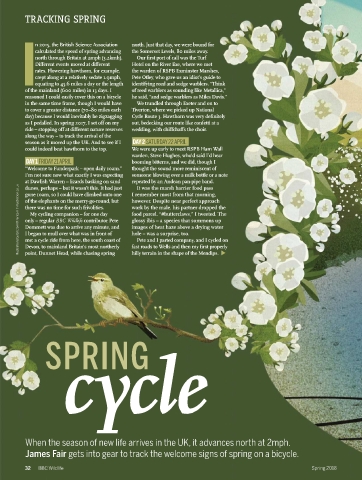
          When the season of new life arrives in the UK, it advances north at 2mph.
          James Fair gets into gear to track the welcome signs of spring on a bicycle.

          32  BBC Wildlife                                                                                Spring 2018

