


Page 35 - BBC Wildlife Volume 36 #05
P. 35
TRAC
CKING SPRING
6
two-tone sound that’s point, with nesting
not a bad imitation of seabirds including
5 a car alarm).There are pu ns, guillemots,
black- and red-throated razorbills, fulmars and
divers too, though these kittiwakes an added not in flower her e. It could be because I was
oned, or perhaps I’d not just
are hard to see.The bonus, though all are at altitude, I reaso
train ride is spectacular declining because kept pace with s pring, but overtaken it.
p
– the line runs from of the reduction in At RSPB Leigh
hton Moss, Kevin Kelly
Inverness, but the best sandeel stocks. Look took me on a tou
ur of the reserve. “We’ve got
part is heading inland out for cetaceans here, bitterns here,” he e told me, “but they haven’t
4 from Helmsdale – and too – porpoises and bred for two year rs, and they don’t boom, they
stops at Forsinard. common dolphins grunt.” For reas ons to do with the hydrology
o
http://bit.ly/2G4Zg9T can both be seen, but of the site, the ree
edbeds are in a less-than-
also larger species perfect state, mea aning the bitterns can’t get
6 RSPB such as humpback into condition to breed. So instead I had
DUNNETHEAD and minke whales. to make do with a – successful, this time
Mainland Britain’s www.rspb.org/ – marsh harrier f food pass, the two birds
t
most northerly dunnethead performing like trapeze artists in the sky.
I stayed sever ral hours longer than
anticipated a at Leighton Moss.
Consequent ly, I was short on time andl
caught another r train – Oxenholme to
Penrith – before cycling over to Dufton YHA
under the shadow
w of the North Pennines.
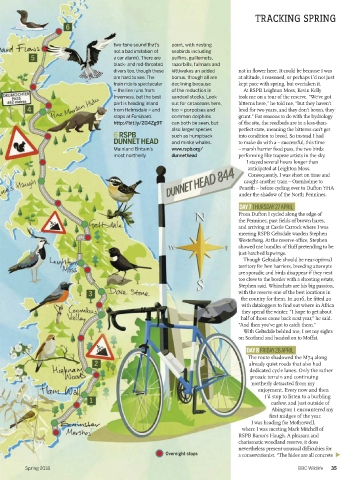
DAY7THURSDAY27APRIL
From Dufton I cy ycled along the edge of
the Pennines, pa st fields of brown hares,
and arriving at C astle Carrock where I was
meeting RSPB G
Geltsdale warden Stephen
h
Westerberg. At t he reserve office, Stephen
showed me bund dles of fluff pretending to be
wings.
just-hatched lapw
Though Gelts dale should be near-optimal
d
harriers, breeding attempts
territory for hen h
are sporadic and birds disappear if they nest
too close to the b order with a shooting estate,
hinchats are his big passion,
Stephen said. Wh
3 with the reserve o one of the best locations in
the country for t them. In 2016, he fitted 20
with datalogger s to find out where in Africa
winter. “I hope to get about
they spend the w
me back next year,” he said.
half of those com
“And then you’ve e got to catch them.”
With Geltsdale e behind me, I set my sights
on Scotland and headed on to Moffat.
DAY8FRIDAY28APRIL
The route sh
hadowed the M74 along
2 already quie et roads that also had
dedicated c cycle lanes. Only the rather
prosaic terr rain and continuing
northerly detracted from my
d
enjoym
ment. Every now and then
I’d st top to listen to a burbling
1 cu
urlew, and just outside of
A
Abington I encountered my
fir st midges of the year.
I was head i ing for Motherwell,
where I was me eeting Mark Mitchell of
RSPB Baron’s H augh. A pleasant and
a
dland reserve, it does
charismatic wood
nevertheless pres sent unusual difficulties for
Overnight stops a conservationist . “The hides are all concrete
ldl
Wi
35
if
BBC
Spring 2018 BBC Wi ldl if e 3 35
BBC Wildlife
BBC Wildlife

