


Page 60 - BBC Wildlife Volume 36 #05
P. 60
AGENDA NEWS


          Q EXPERT BRIEFING
         CONSERVATION


         INSIGHT


          NORTH ATLANTIC RIGHT WHALE


                  WITHOUT CHANGES TO HUMAN
                  ACTIVITY THIS SPECIES COULD BE
                  FUNCTIONALLY EXTINCT IN 20-25
                  YEARS, SAYS REGINA ASMUTIS-SILVIA.

              here may be only 450   causes of whale mortality, but
              North Atlantic right whales  while the threat from ships
         Tleft today, making it one of  has decreased in US waters,
          the rarest of the baleen whales.  increasing numbers are dying
          Between April 2017 and January  in lines fixed to lobster and
          2018 some 18 individuals are  crab pots, and fixed nets.
          known to have died – four per  This may be because of the
          cent of the population.    greater strength of the ropes
           All right whales, including  used in these industries or
          the two other species – the  because the whales have shifted
          Southern and North Pacific, are  where they feed to
          characterised by their huge  areas not considered  MORE ARE
          heads, lack of dorsal fins and  important
          white callosities – rough  under previous    ` DYING IN
          patches of skin that turn white  management plans.  LINES FIXED
          because of lice and barnacle  Our current
          colonies that live on them.  focus is to reduce  TO LOBSTER
           Today, North Atlantic right  entanglement in the  AND CRAB
          whales are mainly found along  fixed-gear fisheries.  POTS, AND
          the eastern seaboard of North  We believe the
          America, roughly from the  greatest risk to the  FIXED NETS.”
          Gulf of St Lawrence to Florida,  whales comes from
          and primarily within 50km of  the vertical lines
          the coastline.             that attach the marker buoys
           Where they now live exposes
                                     to the pots on the seabed, and
       N ck Hawk ns/naturepl.com  them to high levels of human  we are working on a solution
                                     that does away with the need
          impacts, including shipping,
          fishing, pollution and noise.
                                     for these lines.
          Ship strikes and entanglement
                                      We have previously shown
                                     that we can find the answers
          in fishing gear are the two main
                                     to problems like this – since
                        North Atlantic   a seasonal, 10 knot (19kmh)
                       right whale range
                                     speed limit was put in place
                                     for vessels, whale mortality from
                                     ship strikes in US waters has
                                     reduced by 80–90 per cent.
                                     REGINA ASMUTIS-SILVIA is executive
                                     director (North America) for Whale and
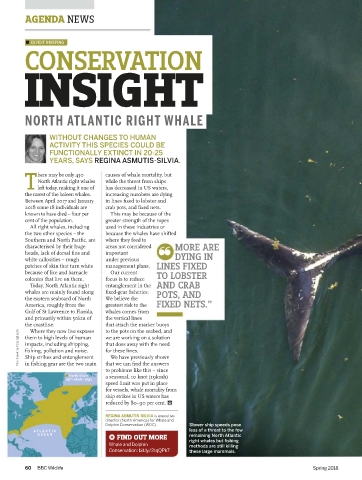
                                     Dolphin Conservation  ((WDC). )  Slower ship speeds pose
            A T L A N T I C                                      less of a threat to the few
              O C E A N                                          remaining North Atlantic
                                      + FIND OUT MORE            right whales but fishing
                                      Whale and Dolphin          methods are still killing
                                      Conservation: bit.ly/2tqQPk7  these large mammals.

          60  BBC Wildlife                                                                                 Spring 2018

