


Page 71 - (DK Eyewitness) Travel Guide - Washington, DC
P. 71
THE M ALL 69
the importance of the collection as videos and documentaries
was recognized. The Smithsonian on African art and culture. The
Institution acquired Robbins’ museum now also holds 525
collection in 1979, and the pieces of the Walt Disney-
works were finally moved to Tishman African Art Collection.
their current home on the The Warren M. Robbins Library
Mall in 1987. has approximately 32,000 books
The 9,000-piece permanent in its collection, mainly on
collection includes both African art, history, and culture.
modern and ancient art from The library, however, also has
Africa, although the majority children’s literature and videos.
of pieces date from the It is open to the public by
19th and 20th centuries. appointment only.
Traditional African art of To display its vast
bronze, ceramics, and archive of exhibits,
gold are on display, the museum runs a
along with an extensive rolling program of
Tribal masks at the National Museum collection of masks. themed exhibitions. It
of African Art There is also a display also hosts performing
of kente cloth from arts events featuring
5 National Museum Ghana – brightly A Benin bronze head dance, music, and the
colored and patterned
spoken word. Year-
of African Art cloth used to adorn at the NMAA round there is a full
clothing as a symbol of calendar of educational
950 Independence Ave, SW.
Map 3 C4. Tel (202) 633-4600. African nationalism. The Eliot tours, lectures, and work shops,
q Smithsonian. Open 10am–5:30pm Elisofon Photographic Archives including many for children. At
daily. Closed Dec 25. 8 7 = d (Eliot Elisofon was a famous the bi-monthly Music of Africa
∑ africa.si.edu photographer for Life magazine) workshop, children over six can
contain 300,000 prints and play African musical instruments
Washington’s National Museum some 120,000 ft of edited and and learn about different rhythms
of African Art is one of the most unedited film footage, as well as well as playing techniques.
peaceful spots on the Mall.
Perhaps because it is mostly History of the Mall
underground, with a relatively
low above-ground presence, In September, 1789, French-born Pierre L’Enfant (1754–1825)
it is often missed by visitors. was invited by George Washington to design the capital of the
The entrance pavilion, situated new United States. While the rest of the city developed, the area
in the Enid A. Haupt Garden planned by L’Enfant to be the Grand Avenue, running west from
directly in front of the the Capitol, remained swampy and undeveloped. In 1850, landscape
Smithsonian Castle, leads gardener Andrew Jackson Downing was employed to develop
to three subterranean floors, the land in accordance with L’Enfant’s plans. However, the money
where the museum shares ran out, and the work was abandoned. At the end of the Civil War
in 1865, President Lincoln, eager that building in the city should
space with the adjacent progress, instructed that work on the area should begin again,
Ripley Center and the Arthur and the Mall began to take on the park-like appearance it has
M. Sackler Gallery (see pp74–5). today. The addition of many museums and memorials in the latter
The museum was founded half of the 20th century established the Mall as the cultural heart
in 1964 by Warren Robbins, a of Washington. It is undergoing further renovation to live up to its
former officer in the American name as “America’s Front Yard.”
Foreign Service (he was a
cultural attaché and public
affairs officer), and was the
first museum in the US to
concentrate entirely on the
art and culture of the African
continent. It was first situated in
the home of Frederick Douglass
(see p147), on Capitol Hill. For
several years Robbins had to
finance the museum himself,
gradually acquiring more space
in the form of a collection of
town houses near the original
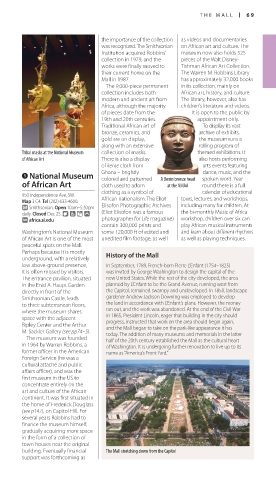
building. Eventually financial The Mall stretching down from the Capitol
support was forthcoming as
068-069_EW_Washington.indd 69 04/04/17 2:38 pm

