


Page 99 - (DK Eyewitness) Travel Guide - Washington, DC
P. 99
PENN QU AR TER 97
Pennsylvania Avenue leads into
E Street, are the Warner Theatre
and the National Theatre. South
of the plaza is the Beaux Arts
District Building (housing
government employees). The
Freedom Plaza is a popular site
for festivals and political protests.
0 Willard Hotel
1401 Pennsylvania Ave, NW. Map 3 B3.
Tel (202) 628-9100. q Metro Center.
7 ∑ washington.
intercontinental.com
There has been a hotel on
this site since 1816. Originally
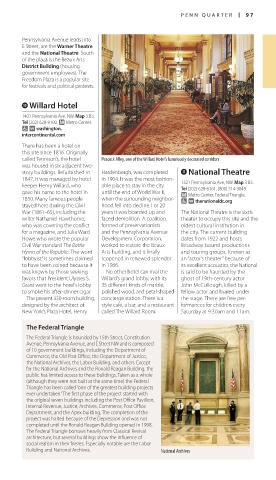
called Tennison’s, the hotel Peacock Alley, one of the Willard Hotel’s luxuriously decorated corridors
was housed in six adjacent two-
story build ings. Refurbished in Hardenbergh, was completed q National Theatre
1847, it was managed by hotel in 1904. It was the most fashion- 1321 Pennsylvania Ave, NW. Map 3 B3.
keeper Henry Willard, who able place to stay in the city Tel (202) 628-6161, (800) 514-3849.
gave his name to the hotel in until the end of World War II, q Metro Center, Federal Tri angle.
1850. Many famous people when the surrounding neighbor- 7 ∑ thenationaldc.org
stayed here during the Civil hood fell into decline. For 20
War (1861–65), including the years it was boarded up and The National Theatre is the sixth
writer Nathaniel Hawthorne, faced demolition. A coalition, theater to occupy this site and the
who was covering the conflict formed of preservationists oldest cultural institution in
for a magazine, and Julia Ward and the Pennsylvania Avenue the city. The current building
Howe who wrote the popular Development Corpor ation, dates from 1922 and hosts
Civil War standard The Battle worked to restore the Beaux Broadway-bound productions
Hymn of the Republic. The word Arts building, and it finally and touring groups. Known as
“lobbyist” is sometimes claimed reopened in renewed splendor an “actor’s theater” because of
to have been coined because it in 1986. its excellent acoustics, the National
was known by those seeking No other hotel can rival the is said to be haunted by the
favors that President Ulysses S. Willard’s grand lobby, with its ghost of 19th-century actor
Grant went to the hotel’s lobby 35 different kinds of marble, John McCullough, killed by a
to smoke his after-dinner cigar. polished wood, and petal-shaped fellow actor and buried under
The present 330-room building, concierge station. There is a the stage. There are free per-
designed by the architect of style café, a bar, and a restaurant formances for children every
New York’s Plaza Hotel, Henry called The Willard Room. Saturday at 9:30am and 11am.
The Federal Triangle
The Federal Triangle is bounded by 15th Street, Constitution
Avenue, Pennsylvania Avenue, and E Street NW and is composed
of 10 government buildings, including the Department of
Commerce, the Old Post Office, the Department of Justice,
the National Archives, the Labor Building, and others. Except
for the National Archives and the Ronald Reagan Building, the
public has limited access to these buildings. Taken as a whole
(although they were not built at the same time) the Federal
Triangle has been called “one of the greatest building projects
ever undertaken.” The first phase of the project started with
the original seven buildings including the Post Office Pavillion,
Internal Revenue, Justice, Archives, Commerce, Post Office
Department, and the Apex building. The completion of the
project was halted because of the Depression and was not
completed until the Ronald Reagan Building opened in 1998.
The Federal Triangle borrows heavily from Classical Revival
architecture, but several buildings show the influence of
social realism in their friezes. Especially notable are the Labor
Building and National Archives. National Archives
096-097_EW_Washington.indd 97 04/04/17 2:39 pm

