


Page 38 - History of War - Issue 01-14
P. 38
did not strand, it would be carried out again on
                                                                                           the ebb”. This was less than perfect, but not
                                                                                           discouraging enough to call off the operation.
                                                                                           In any case, Montagu refl ected, the “object” in
                                                                                           question was a man in a life jacket – larger than
                                                                                           the object the hydrographer had been asked
                                                                                           to speculate about – and might be expected
                                                                                           to catch an onshore wind and drift landwards.
                                                                                           He concluded: “The currents on the coast
                                                                                           are unhelpful at any point, but the prevailing
                                                                                           southwest wind will bring the body ashore if
                                                                                           Jewell can ditch it near enough to the coast.”
                                                                                           A swamp of detail
                                                                                           In the last week of March, Montagu drew up a
                                                                                           seven-point progress report for Johnnie Bevan
                                                                                           [the man in overall control of wartime deception].
                                                                                           Bevan had just returned from North Africa,
                                                                                           where he had coordinated plans for Operation
                                                                                           Barclay with Lt Colonel Dudley Clarke. Relations
                                                                                           between Montagu and Bevan remained tense.
                                                                                           “I am not quite clear as to who is in sole charge
                                                                                           of administrative arrangements in connection
                                                                                           with this operation,” Bevan wrote to Montagu
                                                                                           in a note calculated to rile him. “I think we all
                                                                                           agree that there are a number of things that
                                                                                           might go wrong.” Montagu was in no doubt that
                                                                                           he was in sole charge of the operation, even if
                                                                                           Bevan did not see it that way. Privately, Montagu
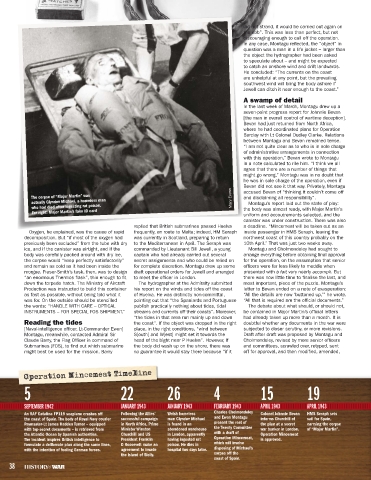
                 The corpse of “Major Martin” was                                      Mary Evans  accused Bevan of “thinking it couldn’t come off
                                                                                           and disclaiming all responsibility”.
                 actually Glyndwr Michael, a homeless man                                    Montagu’s report laid out the state of play:
                 who had died after ingesting rat poison.                                  the body was almost ready, with Major Martin’s
                 Far right: Major Martin’s fake ID card                                    uniform and accoutrements selected, and the
                                                                                           canister was under construction. There was also
                                                     replied that British submarines passed Huelva   a deadline. “Mincemeat will be taken out as an
                Oxygen, he explained, was the cause of rapid   frequently, en route to Malta; indeed, HM Seraph   inside passenger in HMS Seraph, leaving the
              decomposition. But “if most of the oxygen had   was currently in Scotland, preparing to return   northwest coast of this country probably on the
              previously been excluded” from the tube with dry   to the Mediterranean in April. The Seraph was   10th April.” That was just two weeks away.
              ice, and if the canister was airtight, and if the   commanded by Lieutenant Bill Jewell, a young   Montagu and Cholmondeley had sought to
              body was carefully packed around with dry ice,   captain who had already carried out several   arrange everything before obtaining fi nal approval
              the corpse would “keep perfectly satisfactorily”   secret assignments and who could be relied on   for the operation, on the assumption that senior
              and remain as cold as it had been inside the   for complete discretion. Montagu drew up some   offi cers were far less likely to meddle when
              morgue. Fraser-Smith’s task, then, was to design   draft operational orders for Jewell and arranged   presented with a fait very nearly accompli. But
              “an enormous Thermos fl ask”, thin enough to fi t   to meet the offi cer in London.  there was now little time to fi nalise the last, and
              down the torpedo hatch. The Ministry of Aircraft   The hydrographer at the Admiralty submitted   most important, piece of the puzzle. Montagu’s
              Production was instructed to build this container   his report on the winds and tides off the coast   letter to Bevan ended on a note of exasperation:
              as fast as possible, without being told what it   of Huelva. He was distinctly non-committal,   “All the details are now ‘buttoned up,’” he wrote.
              was for. On the outside should be stencilled   pointing out that “the Spaniards and Portuguese   “All that is required are the offi cial documents.”
              the words: “HANDLE WITH CARE – OPTICAL   publish practically nothing about tides, tidal   The debate about what should, or should not,
              INSTRUMENTS – FOR SPECIAL FOS SHIPMENT.”  streams and currents off their coasts”. Moreover,   be contained in Major Martin’s offi cial letters
                                                     “the tides in that area run mainly up and down   had already taken up more than a month. It is
              Reading the tides                      the coast”. If the object was dropped in the right   doubtful whether any documents in the war were
              [Naval-intelligence offi cer, Lt-Commander Ewen]   place, in the right conditions, “wind between   subjected to closer scrutiny, or more revisions.
              Montagu, meanwhile, contacted Admiral Sir   S[outh] and W[est] might set it towards the   Draft after draft was proposed by Montagu and
              Claude Barry, the Flag Offi cer in command of   head of the bight near P Huelva”. However, if   Cholmondeley, revised by more senior offi cers
              Submarines (FOS), to fi nd out which submarine   the body did wash up on the shore, there was   and committees, scrawled over, retyped, sent
              might best be used for the mission. Barry   no guarantee it would stay there because “if it   off for approval, and then modifi ed, amended,


              Operation Mincemeat Timeline


              5                                 22               26              4               15               19


              SEPTEMBER 1942                    JANUARY 1943     JANUARY 1943    FEBRUARY 1943   APRIL 1943       APRIL 1943
              An RAF Catalina FP119 seaplane crashes off   Following the Allies’   Welsh homeless   Charles Cholmondeley   Colonel Johnnie Bevan   HMS Seraph sets
              the coast of Spain. The body of Royal Navy courier   successful campaign   man Glyndwr Michael   and Ewen Montagu   informs Churchill of   sail for Spain,
              Paymaster-Lt James Hadden Turner – equipped   in North Africa, Prime   is found in an   present the rest of   the plan at a secret   carrying the corpse
              with top-secret documents – is retrieved from   Minister Winston   abandoned warehouse   the Twenty Committee   war bunker in London.   of “Major Martin”.
              the Atlantic Ocean by Spanish authorities.   Churchill and US   in London, apparently   with a draft of   Operation Mincemeat
              The incident inspires British intelligence to   President Franklin   having ingested rat   Operation Mincemeat,   is approved.
              formulate a deliberate plan along the same lines,   D Roosevelt make an   poison. He dies in   which will involve
              with the intention of fooling German forces.  agreement to invade   hospital two days later.  disposing of Michael’s
                                                the island of Sicily.            corpse off the
                                                                                 coast of Spain.
         38   HISTORY  WAR
                       of


        HoW01.Operation Mincemeat.indd   38                                                                                  30/01/2014   16:29

