


Page 68 - History of War - Issue 01-14
P. 68
Military M IL E ST O N E S
AVIONICS
From hot-air balloons to remote-controlled drone bombers,
the advances in military aviation have been astonishing. .
We look back at the aircraft that have revolutionised warfare…
We look back at the aircraft that have revolutionised warfare…
17 9 4 B ALLOONING 1944 NORTH AMERICAN P-51 MUSTANG
NORTH
AN P-51 MUSTANG
AMERIC
1794 BALLOONING
arded as
America’
nest fi
s fi
ghter plane during
Re
g
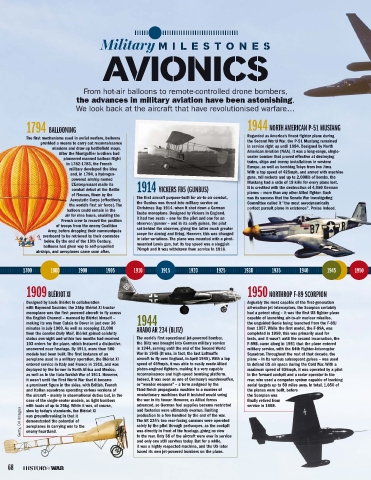
The fi rst mechanisms used in aerial w arfare, balloons Regarded as America’s finest fighter plane during
The first mechanisms used in aerial warfare, balloons
W
W
or
ld
the P-51 Mustang remained
the Second
ar
,
provided a means to carry out reconnaissance the Second World War, the P-51 Mustang remained
r
provided a means to car
y out reconnaissance
vice right up until 1984.
in ser
y Nor
Designed b
th
eld maps.
w up battlefi
a
missions and draw up battlefield maps. in service right up until 1984. Designed by North
missions and dr
e,
Aviation (NAA),
it w
ang
American
as a long-r
single-
er brothers had
olfi
After the Montgolfier brothers had American Aviation (NAA), it was a long-range, single-
After the Montg
seater bomber that proved effective at destro
ying
ight
pioneered manned balloon fl
pioneered manned balloon flight seater bomber that proved effective at destroying
ships and enemy installations in wester
ships and enemy installations in wester
n
ships and enemy installations in wester
n
ains,
tr tr tr
ains,
n
ains,
in 1782-1783, the French trains, ships and enemy installations in western
in 1782-1783, the French
as well as bombing
okyo from Iwo Jima.
Europe,
Europe, as well as bombing Tokyo from Iwo Jima.
military developed the idea Europe, as well as bombing T T okyo from Iwo Jima.
y developed the idea
militar
ith a top speed of 425mph,
ith a top speed of 425mph,
med with machine
med with machine
and ar
and ar
W W
and, in 1794, a hydrogen-
and, in 1794, a h ydrog en- With a top speed of 425mph, and armed with machine
ets and up to 2,000lb of bombs,
guns,
guns, rail rockets and up to 2,000lb of bombs, the
the
ail rock
powered airship named guns, r r ail rock ets and up to 2,000lb of bombs, the
atio of 19 kills for ever
atio of 19 kills for ever
Mustang had a r
y plane lost.
Mustang had a r
y plane lost.
L’Entreprenant made its Mustang had a ratio of 19 kills for every plane lost.
man
uction of 4,950 Ger
It is credited with the destruction of 4,950 German
It is credited with the destr
combat debut at the Battle
combat debut at the Battle 1914 VICKERS FB5 (GUNBUS) It is credited with the destr uction of 4,950 Ger man
e
n
n
a
l
l
a
p p
e
ghter
ghter
Such
Such
.
.
Allied fi
s
s
– more than an
y other
Allied fi
– more than an
y other
of Fleurus, flown by the planes – more than any other Allied fighter. Such
of Fleurus, fl
own by the
ar In
W
as its success that the Senate
ating
ating
as its success that the Senate
ar In
vestig
vestig
W
Aerostatic Corps (effectively,
Aerostatic Corps (effectively, The first aircraft purpose-built for air-to-air combat, w w was its success that the Senate War Investigating
d
t
t
m
it
“the most aerodynamically
i
l
a
c
e
e
e
l
m
o
the world’s fi
rst air force). The
the world’s first air force). The the Gunbus was thrust into military service on C Committee called it “the most aerodynamically
perfect pursuit plane in existence”. Praise indeed.
balloon could remain in the
balloon could remain in the Christmas Day 1914, when it shot down a German perfect pursuit plane in existence”. Pr aise indeed.
air for nine hours, enabling the Taube monoplane. Designed by Vickers in England,
air for nine hours, enabling the
French crew to record the position
French crew to record the position it had two seats – one for the pilot and one for an
of troops from the enemy Coalition
of troops from the enemy Coalition observer/gunner – and in its early guises, the pilot
Army, before dropping their communiqués sat behind the observer, giving the latter much greater
Army, before dropping their communiqués
overboard to be retrieved by their comrades scope for aiming and firing. However, this was changed
overboard to be retrieved by their comrades
below. By the end of the 19th Century, in later variations. The plane was mounted with a pivot-
below. By the end of the 19th Century,
balloons had given way to self-propelled
balloons had given way to self-propelled mounted Lewis gun, but its top speed was a sluggish
airships, and aeroplanes came soon after. 70mph and it was withdrawn from service in 1916.
airships, and aeroplanes came soon after.
1700 1800 1900 1905 1910 1915 1920 1925 1930 1935 1940 1945 1950
1909 BLÉRIOT XI 1950 NORTHROP F-89 SCORPION
Designed by Louis Blériot in collaboration Arguably the most capable of the first-generation
with Raymond Saulnier, the 25hp Blériot XI tractor all-weather jet interceptors, the Scorpion certainly
monoplane w as the fi rst powered air cr aft to fl y across had a potent sting – it was the first US fighter plane
monoplane was the first powered aircraft to fly across
4
19
4
the English Channel – manned by Blériot himself – 1944 capable of launching air-to-air nuclear missiles,
making its way from Calais to Dover in just over 36 the unguided Genie being launched from the F-89J
minutes in July 1909. As well as scooping £1,000 ARADO AR 234 (BLITZ) from 1957. While the first model, the F-89A, was
from the London Daily Mail, Blériot gained celebrity completed in 1950, this was primarily used for
status overnight and within two months had received The world’s first operational jet-powered bomber, tests, and it wasn’t until the second incarnation, the
103 orders for the plane, which featured a distinctive, the Blitz was brought into German military service F-89B, came along in 1951 that the plane entered
uncovered near fuselage. By 1911, more than 500 in 1944, serving until the end of the Second World military service, with the 84th Fighter-Interceptor
models had been built. The first instance of an War in 1945 (it was, in fact, the last Luftwaffe Squadron. Throughout the rest of that decade, the
aeroplane used in a military operation, the Blériot XI aircraft to fly over England, in April 1945). With a top plane – in its various subsequent guises – was used
entered service in Italy and France in 1910, and was speed of 459mph, it was able to easily evade Allied to defend US air space during the Cold War. With a
deployed by the former in North Africa and Mexico, piston-engined fighters, making it a very capable maximum speed of 636mph, it was operated by a pilot
as well as in the Italo-Turkish War of 1911. However, reconnaissance and high-speed bombing platform. in the forward cockpit and a radar operator in the
it wasn’t until the First World War that it became Indeed, it was seen as one of Germany’s wunderwaffen, rear, who used a computer system capable of tracking
w
a
In total,
y
.
ets up to 50 miles a
aerial targ
1,050 of
a prominent figure in the skies, with British, French or “wonder weapons” – a term assigned by the aerial targets up to 50 miles away. In total, 1,050 of
the planes were built, before
and Italian squadrons operating various versions of Third Reich propaganda machine to a number of the planes were built, before
the Scorpion was
the aircraft – mainly in observational duties but, in the revolutionary machines that it insisted would swing the Scorpion w as
fi
case of the single-seater models, as light bombers the war in its favour. However, as Allied forces finally retired from
nally retired from
service in 1969.
with loads of up to 25kg. While it was, of course, advanced, so German fuel supplies became restricted ser vice in 1969.
Getty, DK Images w as g roundbreaking in that it production to a few hundred by the end of the war.
and factories were ultimately overrun, limiting
the Blériot XI
slow b
y’
y toda
slow by today’s standards, the Blériot XI
s standards,
was groundbreaking in that it
The AR 234’s two rear-facing cannons were operated
ated the potential of
demonstr
demonstrated the potential of
solely by the pilot through periscopes, as the cockpit
ying w
ar to the
aeroplanes in car
r
aeroplanes in carrying war to the
was directly in front of the fuselage, giving no view
tland.
enemy hear
enemy heartland.
to the rear. Only 38 of the aircraft were ever in service
and only one still survives today. But for a while,
it was a highly respected machine, and the US later
based its own jet-powered bombers on the plane.
68 HISTORY WAR
of

