


Page 100 - Forbes - USA (November 2019)
P. 100
96


       0
       5

       H
       C
       E
       T
       N
       I
       F

       •

       D
       N
       E
       R
       T

       E
       H
       T


              Bandwagon
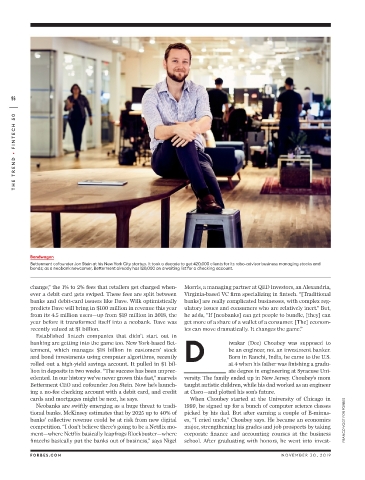
              Betterment cofounder Jon Stein at his New York City startup. It took a decade to get 420,000 clients for its robo-advisor business managing stocks and
              bonds; as a neobank newcomer, Betterment already has 120,000 on a waiting list for a checking account.


              change,” the 1% to 2% fees that retailers get charged when-       Morris, a managing partner at QED Investors, an Alexandria,
              ever a debit card gets swiped. These fees are split between       Virginia-based VC firm specializing in fintech. “[Traditional
              banks and debit-card issuers like Dave. Wilk optimistically       banks] are really complicated businesses, with complex reg-
              predicts Dave will bring in $100 million in revenue this year     ulatory issues and consumers who are relatively inert.” But,
              from its 4.5 million users—up from $19 million in 2018, the       he adds, “If [neobanks] can get people to bundle, [they] can
              year before it transformed itself into a neobank. Dave was        get more of a share of a wallet of a consumer. [The] econom-
              recently valued at $1 billion.                                    ics can move dramatically. It changes the game.”
                 Established  fintech  companies  that  didn’t  start  out  in
              banking are getting into the game too. New York-based Bet-                           iwakar  (Dee)  Choubey  was  supposed  to
              terment,  which  manages  $18  billion  in  customers’  stock     D                  be an engineer, not an investment banker.
              and bond investments using computer algorithms, recently                             Born in Ranchi, India, he came to the U.S.
              rolled out a high-yield savings account. It pulled in $1 bil-                        at 4 when his father was finishing a gradu-
              lion in deposits in two weeks. “The success has been unprec-                         ate degree in engineering at Syracuse Uni-
              edented. In our history we’ve never grown this fast,” marvels     versity. The family ended up in New Jersey. Choubey’s mom
              Betterment CEO and cofounder Jon Stein. Now he’s launch-          taught autistic children, while his dad worked as an engineer
              ing a no-fee checking account with a debit card, and credit       at Cisco—and plotted his son’s future.
              cards and mortgages might be next, he says.                          When  Choubey  started  at  the  University  of  Chicago  in
                 Neobanks are swiftly emerging as a huge threat to tradi-       1999, he signed up for a bunch of computer science classes
              tional banks. McKinsey estimates that by 2025 up to 40% of        picked by his dad. But after earning a couple of B-minus-
              banks’ collective revenue could be at risk from new digital       es, “I cried uncle,” Choubey says. He became an economics            FRANCO VOGT FOR FORBES
              competition. “I don’t believe there’s going to be a Netflix mo-    major, strengthening his grades and job prospects by taking
              ment—where Netflix basically leapfrogs Blockbuster—where           corporate  finance  and  accounting  courses  at  the  business
              fintechs basically put the banks out of business,” says Nigel      school. After graduating with honors, he went into invest-


              F O R B E S . C O M                                                                                         N O V E M B E R   3 0 ,   2 0 1 9

