


Page 104 - Forbes - USA (November 2019)
P. 104
100


       0
       5

       H
       C
       E
       T
       N
       I
       F

       •

       D
       N
       E
       R
       T

       E
       H
       T


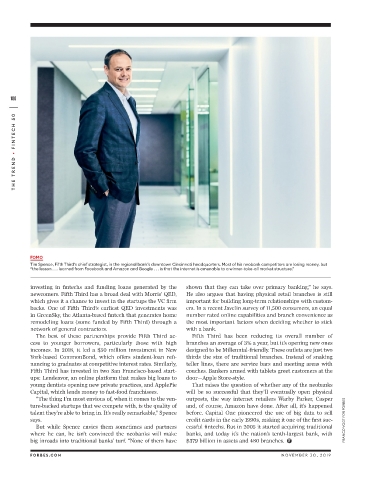
              FOMO
              Tim Spence, Fifth Third’s chief strategist, in the regional bank’s downtown Cincinnati headquarters. Most of his neobank competitors are losing money, but
              “the lesson . . . learned from Facebook and Amazon and Google . . . is that the internet is amenable to a winner-take-all market structure.”


              investing  in  fintechs  and  funding  loans  generated  by  the    shown that they can take over primary banking,” he says.
              newcomers. Fifth Third has a broad deal with Morris’ QED,          He also argues that having physical retail branches is still
              which gives it a chance to invest in the startups the VC firm       important for building long-term relationships with custom-
              backs. One of Fifth Third’s earliest QED investments was           ers. In a recent Javelin survey of 11,500 consumers, an equal
              in GreenSky, the Atlanta-based fintech that generates home          number rated online capabilities and branch convenience as
              remodeling loans (some funded by Fifth Third) through a            the most important factors when deciding whether to stick
              network of general contractors.                                    with a bank.
                 The  best  of  these  partnerships  provide  Fifth  Third  ac-     Fifth  Third  has  been  reducing  its  overall  number  of
              cess  to  younger  borrowers,  particularly  those  with  high     branches an average of 3% a year, but it’s opening new ones
              incomes. In 2018, it led a $50 million investment in New           designed to be Millennial-friendly. These outlets are just two
              York-based  CommonBond,  which  offers  student-loan  refi-         thirds the size of traditional branches. Instead of snaking
              nancing to graduates at competitive interest rates. Similarly,     teller lines, there are service bars and meeting areas with
              Fifth Third has invested in two San Francisco-based start-         couches. Bankers armed with tablets greet customers at the
              ups: Lendeavor, an online platform that makes big loans to         door—Apple Store-style.
              young dentists opening new private practices, and ApplePie            That raises the question of whether any of the neobanks
              Capital, which lends money to fast-food franchisees.               will  be  so  successful  that  they’ll  eventually  open  physical
                 “The thing I’m most envious of, when it comes to the ven-       outposts,  the  way  internet  retailers  Warby  Parker,  Casper
              ture-backed startups that we compete with, is the quality of       and, of course, Amazon have done. After all, it’s happened
              talent they’re able to bring in. It’s really remarkable,” Spence   before.  Capital  One  pioneered  the  use  of  big  data  to  sell
              says.                                                              credit cards in the early 1990s, making it one of the first suc-     FRANCO VOGT FOR FORBES
                 But  while  Spence  envies  them  sometimes  and  partners      cessful fintechs. But in 2005 it started acquiring traditional
              where  he  can,  he  isn’t  convinced  the  neobanks  will  make   banks, and today it’s the nation’s tenth-largest bank, with
              big inroads into traditional banks’ turf. “None of them have       $379 billion in assets and 480 branches.


              F O R B E S . C O M                                                                                         N O V E M B E R   3 0 ,   2 0 1 9

