


Page 44 - Forbes - USA (November 2019)
P. 44
Daphne Koller Cont.                                                          weeks instead of years,” Koller says.


                        N                                                                  made in heaven” for investors, she says. Within six
                                                                                              AI plus biology, her background, was a “marriage


                                                                                           months  Koller  raised  $100  million  from  ARCH
                                                                                           Ventures,  Andreessen  Horowitz,  Foresite  Capital,
      40                                                                                   Alphabet’s venture fund GV and Third Rock, with

                                                                                           Jeff  Bezos  and  others  joining  later.  In  April,  she
       N                                                               HOW TO PLAY IT      landed a deal with Gilead Sciences that gives Insi-
                                                                         According to
       O                                                                                   tro $15 million now with $1 billion to follow if it
       I                                                                Gary Robinson      helps find a treatment for a deadly form of nonal-

       V A T                                                            Quantum com-       coholic fatty liver disease. The disease is expected to
       O                                                               puting and AI are   soon become the leading cause of liver transplants.
       N                                                               massive tailwinds
       N                              Not  many  scientists  get        for healthcare        “There are very few individuals who understand
       I                                                               research and San
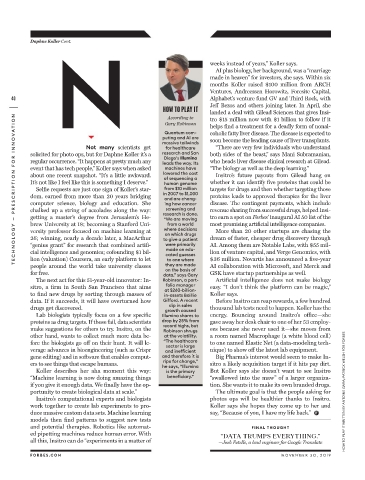
              solicited for photo ops, but for Daphne Koller it’s a                        both sides of the beast,” says Mani Subramanian,
       R                                                                Diego’s Illumina
       O      regular occurrence. “It happens at pretty much any       leads the way. Its   who heads liver disease clinical research at Gilead.
       F
              event that has tech people,” Koller says when asked       machines have      “The biology as well as the deep learning.”
       N                                                               lowered the cost
       O      about one recent snapshot. “It’s a little awkward.        of sequencing a       Insitro’s  future  payouts  from  Gilead  hang  on

       I                                                                                   whether it can identify five proteins that could be
       T      It’s not like I feel like this is something I deserve.”   human genome
       P

       I         Selfie requests are just one sign of Koller’s star-    from $10 million   targets for drugs and then whether targeting those
       R                                                               in 2007 to $1,000
       C      dom, earned from more than 20 years bridging              and are chang-     proteins leads to approved therapies for the liver
       S      computer  science,  biology  and  education.  She                            disease. The contingent payments, which include
       E                                                                ing how cancer
       R      chalked up a string of accolades along the way:           screening and      revenue sharing from successful drugs, helped Insi-
       P
              getting  a  master’s  degree  from  Jerusalem’s  He-     research is done.   tro earn a spot on Forbes’ inaugural AI 50 list of the
       —                                                                “We are moving
                                                                                           most promising artificial intelligence companies.

       Y      brew University at 18; becoming a Stanford Uni-            from a world
       G      versity professor focused on machine learning at          where decisions       More than 20 other startups are chasing the
       O                                                                on which drugs
       L      26; winning, nearly a decade later, a Mac Arthur         to give a patient   dream of faster, cheaper drug discovery through
       O                                                                were primarily     AI. Among them are Notable Labs, with $55 mil-

       N      “genius grant” for research that combined artifi-
       H      cial intelligence and genomics; cofounding $1 bil-        made on edu-       lion of venture capital, and Verge Genomics, with
       C                                                                cated guesses

       E      lion (valuation) Coursera, an early platform to let        to one where      $36 million. Novartis has announced a five-year
       T
              people  around  the  world  take  university  classes     they are made      AI collaboration with Microsoft, and Merck and
                                                                        on the basis of
              for free.                                                data,” says Gary    GSK have startup partnerships as well.
                 The next act for this 51-year-old innovator: In-      Robinson, a port-      Artificial  intelligence  does  not  make  biology

                                                                        folio manager

              sitro,  a  firm  in  South  San  Francisco  that  aims    at $260-billion-   easy. “I don’t think the platform can be magic,”

              to find new drugs by sorting through masses of            in-assets Baillie   Koller says.

              data. If it succeeds, it will have overturned how        Gifford. A recent      Before Insitro can reap rewards, a few hundred
                                                                          dip in sales
              drugs get discovered.                                                        thousand lab tests need to happen. Koller has the
                                                                        growth caused


                 Lab  biologists  typically  focus  on  a  few  specific   Illumina shares to   energy.  Bouncing  around  Insitro’s  office—she
              proteins as drug targets. If those fail, data scientists   drop by 25% from   gave away her desk chair to one of her 53 employ-
                                                                       record highs, but
              make suggestions for others to try. Insitro, on the      Robinson shrugs     ees because she never used it—she moves from
              other hand, wants to collect much more data be-           at the volatility.   a room named Macrophage (a white blood cell)

              fore the biologists go off on their hunt. It will le-    “The healthcare     to one named Elastic Net (a data-modeling tech-
                                                                        sector is large

              verage advances in bioengineering (such as Crispr         and inefficient    nique) to show off the latest lab equipment.


              gene editing) and in software that enables comput-       and therefore it is    Big Pharma’s interest would seem to make In-
                                                                       ripe for change,”
              ers to see things that escape humans.                                        sitro a likely acquisition target if it hits pay dirt.
                                                                       he says, “Illumina
                 Koller  describes  her  aha  moment  this  way:         is the primary    But  Koller  says  she  doesn’t  want  to  see  Insitro

              “Machine learning is now doing amazing things              beneficiary.”     “swallowed into the maw” of a larger organiza-

              if you give it enough data. We finally have the op-                          tion. She wants it to make its own branded drugs.
              portunity to create biological data at scale.”                                  The ultimate goal is that the people asking for        HOW TO PLAY IT WRITTEN BY ANTOINE GARA; PATRICK WELSH FOR FORBES
                 Insitro’s computational experts and biologists                            photos  ops  will  be  healthier  thanks  to  Insitro.
              work together to create lab experiments to pro-                              Koller says she hopes they come up to her and
              duce massive custom data sets. Machine learning                              say, “Because of you, I have my life back.”   F

              models  then  find  patterns  to  suggest  new  tests
              and potential therapies. Robotics like automat-                                                F IN AL T HO UG HT
              ed pipetting machines reduce human error. With                                    “DATA TRUMPS EVERYTHING.”
              all this, Insitro can do “experiments in a matter of                             —Josh Estelle, a lead engineer for Google Translate
              F O R B E S . C O M                                                                                         N O V E M B E R   3 0 ,   2 0 1 9

