


Page 48 - Forbes - USA (November 2019)
P. 48
Bigelow Cont.


                                                                     pretty significant conversation to get to that place.”

                                                                        Bigelow now produces two billion tea bags from
                                 Little Big Picture                  its three plants every year, feeding a product line
                               RELATIVE FAILURE                      that comprises 150 flavors. It shuns the more in-

                                                                     dustrial “cut-tear-curl” drying practices as well as
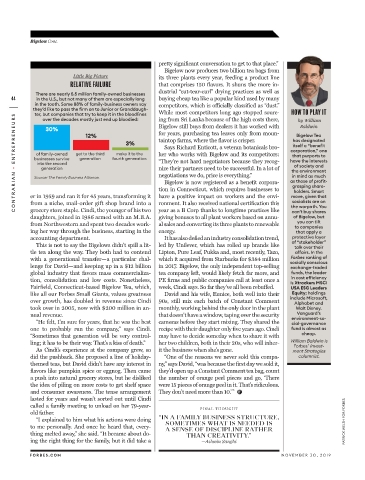
                There are nearly 5.5 million family-owned businesses
      44         in the U.S., but not many of them are especially long   buying cheap tea like a popular kind used by many
                in the tooth. Some 88% of family-business owners say   competitors, which is officially classified as “dust.”


               they’d like to pass the firm on to Junior or Granddaugh-  While most competitors long ago stopped sourc-

       S        ter, but companies that try to keep it in the bloodlines                                                      HOW TO PLAY IT
       R           over the decades mostly just end up bloodied:     ing from Sri Lanka because of the high costs there,          by William
       U
       E             30%                                              Bigelow still buys from dealers it has worked with          Baldwin
       N                                                             for years, purchasing tea leaves only from moun-
       E                              12%                                                                                        Bigelow Tea

       R                                                             taintop farms, where the flavor is crisper.               has designated
       P                                               3%

       E                                                                Says Richard Enticott, a veteran botanicals bro-       itself a “benefit
       R                                                                                                                      corporation,” one
       T         of family-owned   get to the third   make it to the   ker who works with Bigelow and its competitors:         that purports to
       N        businesses survive   generation  fourth generation
       E         into the second                                     “They’re not hard negotiators because they recog-        have the interests
                                                                                                                                of society and
       •           generation                                        nize their partners need to be successful. In a lot of
                                                                                                                               the environment
       N                                                             negotiations we do, price is everything.”                 in mind as much
       A        Source: The Family Business Alliance.


       I                                                                Bigelow is now registered as a benefit corpora-       as those of profit-
       R                                                                                                                       grasping share-
       A                                                             tion in Connecticut, which requires businesses to         holders. Smart
       R
       T      er in 1959 and ran it for 45 years,  transforming it   have  a  positive  impact  on  workers  and  the  envi-  move, given that
       N      from a niche,  mail-order gift shop brand into a       ronment. It also received national certification this     socialists are on

       O                                                                                                                      the warpath. You
       C      grocery store staple. Cindi,  the younger of his two   year as a B Corp thanks to longtime practices like        can’t buy shares
              daughters,  joined in 1986 armed with an M.B.A.        giving bonuses to all plant workers based on annu-        of Bigelow, but
              from Northwestern  and spent two decades work-         al sales and converting its three plants to renewable       you can tilt
                                                                                                                                to companies
              ing her way through the business,  starting in the     energy.                                                    that apply a
              accounting department.                                    It has also defied an industry consolidation trend,    protective layer

                                                                                                                               of “stakeholder”
                 This is not to say the Bigelows didn’t spill a lit-  led  by  Unilever,  which  has  rolled  up  brands  like   talk over their
              tle tea along the way. They both had to contend        Lipton, Pure Leaf, Pukka and, most recently, Tazo,         affairs. In the

              with  a  generational  transfer—a  particular  chal-   which it acquired from Starbucks for $384 million        Forbes ranking of
                                                                                                                              socially conscious
              lenge for David—and keeping up in a $12 billion        in 2017. Bigelow, the only independent top-selling       exchange-traded
              global industry that favors mass commercializa-        tea company left, would likely fetch far more, and       funds, the leader


              tion,  consolidation  and  low  costs.  Nonetheless,   PE firms and public companies call at least once a       in cost efficiency
                                                                                                                              is Xtrackers MSCI
              Fairfield, Connecticut-based Bigelow Tea, which,       week, Cindi says. So far they’ve all been rebuffed.      USA ESG Leaders


              like all our Forbes Small Giants, values greatness        David and his wife, Eunice, both well into their       Equity; holdings

                                                                                                                              include Microsoft,
              over growth, has doubled in revenue since Cindi        90s,  still  mix  each  batch  of  Constant  Comment       Alphabet and
              took over in 2005, now with $200 million in an-        monthly, working behind the only door in the plant         Walt Disney.
              nual revenue.                                          that doesn’t have a window, taping over the security        Vanguard’s
                                                                                                                               environment-so-
                 “He felt, I’m sure for years, that he was the best   cameras before they start mixing. They shared the        cial-governance

              one  to  probably  run  the  company,”  says  Cindi.   recipe with their daughter only five years ago. Cindi    fund is almost as
              “Sometimes  that  generation  will  be  very  control-  may have to decide someday when to share it with             cheap.
              ling; it has to be their way. That’s a kiss of death.”  her two children, both in their 20s, who will inher-    William Baldwin is
                                                                                                                                Forbes’ Invest-
                 As Cindi’s experience at the company grew, so       it the business when she’s gone.                          ment Strategies
              did the pushback. She proposed a line of holiday-         “One of the reasons we never sold this compa-            columnist.
              themed teas, but David didn’t have any interest in     ny,” says David, “was because the first day we sold it,


              flavors like pumpkin spice or eggnog. Then came        they’d open up a Constant Comment tea bag, count
              a push into natural grocery stores, but he disliked    the number of orange peel pieces and go, ‘There
              the idea of piling on more costs to get shelf space    were 15 pieces of orange peel in it. That’s ridiculous.
              and consumer awareness. The tense arrangement          They don’t need more than 10.’ ”  F
              lasted for years and wasn’t sorted out until Cindi
              called a family meeting to unload on her 79-year-
                                                                                       F I NA L   T HOU G H T
              old father.
                 “I explained to him what his actions were doing     “IN A FAMILY BUSINESS STRUCTURE,
                                                                        SOMETIMES WHAT IS NEEDED IS                                                  PATRICK WELSH FOR FORBES
              to me personally. And once he heard that, every-
                                                                        A SENSE OF DISCIPLINE RATHER
              thing melted away,” she said. “It became about do-                 THAN CREATIVITY.”
              ing the right thing for the family, but it did take a                     —Ashwin Sanghi


              F O R B E S . C O M                                                                                         N O V E M B E R   3 0 ,   2 0 1 9

