


Page 104 - Forbes - USA (March 2020)
P. 104
then came to the U.S. to get his Ph.D. in mechanical engi-        build, install, service and fuel these boxes. Subsidies like
              neering. He later worked at the University of Arizona’s Space     the lucrative federal investment tax credit knock off a bit
              Technologies Lab, building an oxygen-generating machine           more—1.5 cents in California. This might appeal to custom-
              for NASA’s missions to Mars. When the Mars Polar Lander           ers paying more per kwh in some high-price states. But the
              crashed in 1999, his project was canceled. Undeterred, he         national  average  for  retail  power  is  10  cents  and  falling,
              worked  to  more  or  less  reverse  that                                                says Ed Hirs, a fellow at the University
              technology, to turn methane and oxy-                                                     of Houston and energy advisor to tax
              gen into carbon dioxide and electricity.                                                 consultancy BDO. “This technology is
                 In 2001 Sridhar cofounded the com-                                                    a nonstarter in most of the country,
      102     pany that became Bloom and soon met                                                      where  Bloom  is  competing  against
              John  Doerr,  the  legendary  billionaire                                                real  renewables  like  solar  and  wind
              venture capitalist who got rich funding                                                  that have come down the cost curve
       N
       O      infotech  companies  such  as  Amazon,                                                   far faster,” Hirs says. “Add in batteries
       I      Google and Sun Microsystems. Doerr’s                                                     and you can achieve similar reliabil-
       A T
       G      firm,  Kleiner  Perkins,  put  about  $60                                                 ity at far lower cost, with no carbon
       I      million into Bloom and still owns close                                                  emissions.”  Los  Angeles  has  entered
       T
       S
       E      to 14% of it after selling roughly half its                                              into a 25-year agreement to buy solar-
       V      stake in the past year. Other long-term                                                  plus-battery power at 2 cents per kwh.
       N
       I      investors  include  venture  shop  New                                                     Bloom  is  a  long  way  from  being

       E
       H      Enterprise Associates, Kuwait’s sover-                                                   able to offer such pricing, though the
       T      eign wealth fund and pension funds in                                                    technology is getting better. Whereas
              Canada and New Zealand.                                                                  its  earliest  boxes  lasted  fewer  than
                                                                                                       two  years  before  they  needed  to  be
             B                  y  2008,  Sridhar  had  True Believer                                  gotten  the  lifespan  up  to  nearly  five
                                                                                                       replaced,  today  Bloom  claims  it  has
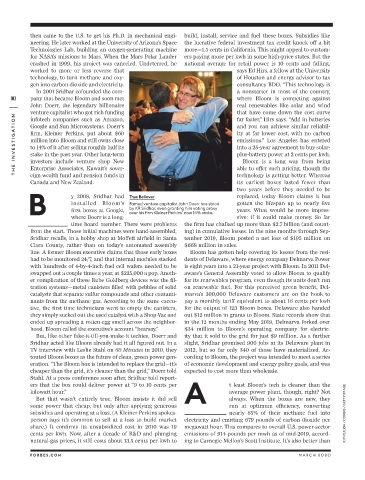
                                installed  Bloom’s  Famed venture capitalist John Doerr has stood
                                                         by KR Sridhar, even granting him voting proxy
                                                                                                       years.  What  would  be  more  impres-
                                first boxes at Google,
                                where Doerr is a long-   over his firm Kleiner Perkins’ now 14% stake.   sive:  if  it  could  make  money.  So  far
                                time board member. There were problems          the firm has chalked up more than $2.7 billion (and count-
              from the start. Those initial machines were hand-assembled,       ing) in cumulative losses. In the nine months through Sep-
              Sridhar recalls, in a hobby shop at Moffett airfield in Santa      tember 2019, Bloom posted a net loss of $195 million on
              Clara  County,  rather  than  on  today’s  automated  assembly    $668 million in sales.
              line. A former Bloom executive claims that those early boxes         Bloom has gotten help covering its losses from the resi-
              had to be monitored 24/7, and that internal modules stacked       dents of Delaware, where energy company Delmarva Power
              with hundreds of 4-by-4-inch fuel cell wafers needed to be        is eight years into a 21-year project with Bloom. In 2011 Del-
              swapped out a couple times a year, at $225,000 a pop. Anoth-      aware’s General Assembly voted to allow Bloom to qualify
              er complication of these Rube Goldberg devices was the fil-        for its renewables program, even though its units don’t run
              tration systems—metal canisters filled with pebbles of solid       on  renewable  fuel.  For  this  perceived  green  benefit,  Del-
              catalysts that separate sulfur compounds and other contami-       marva’s 300,000 Delaware customers are on the hook to
              nants from the methane gas. According to the same execu-          pay a monthly tariff equivalent to about 16 cents per kwh
              tive, the first time technicians went to empty the canisters,      for the output of 123 Bloom boxes. Delaware also handed
              they simply sucked out the used catalyst with a Shop-Vac and      out $12 million in grants to Bloom. State records show that
              ended up spreading a rotten-egg smell across the neighbor-        in the 12 months ending May 2019, Delmarva forked over
              hood. Bloom called the executive’s account “hearsay.”             $34  million  to  Bloom’s  operating  company  for  electric-
                 But, like other fake-it-till-you-make-it techies, Doerr and    ity that it sold to the grid for just $9 million. As a further
              Sridhar acted like Bloom already had it all figured out. In a      slight, Sridhar promised 900 jobs at its Delaware plant in
              TV interview with Leslie Stahl on 60 Minutes in 2010, they        2012, but so far only 340 of those have materialized. Ac-
              touted Bloom boxes as the future of clean, green power gen-       cording to Bloom, the project was intended to meet a series
              eration. “The Bloom box is intended to replace the grid—it’s      of economic development and energy policy goals, and was
              cheaper than the grid, it’s cleaner than the grid,” Doerr told    expected to cost more than wholesale.
              Stahl. At a press conference soon after, Sridhar told report-
              ers that the box could deliver power at “9 to 10 cents per                            t least Bloom’s tech is cleaner than the
              kilowatt hour.”                                                   A                   average power plant, though, right? Not
                 But  that  wasn’t  entirely  true.  Bloom  insists  it  did  sell                  always.  When  the  boxes  are  new,  they
              some power that cheap, but only after applying generous                               run  at  optimum  efficiency,  converting
              subsidies and operating at a loss. (A Kleiner Perkins spokes-                         nearly  65%  of  their  methane  fuel  into       KIM KULISH / CORBIS / GETTY IMAGE
              person says it’s common to sell at a loss to build market         electricity and emitting 679 pounds of carbon dioxide per
              share.)  It  confirms  its  unsubsidized  cost  in  2010  was  19   megawatt hour. This compares to overall U.S. power-sector
              cents per kwh. Now, after a decade of R&D and plunging            emissions of 914 pounds per mwh as of mid-2019, accord-
              natural-gas prices, it still costs about 13.5 cents per kwh to    ing to Carnegie Mellon’s Scott Institute. It’s also better than


              F O R B E S . C O M                                                                                                 M A R C H   2 0 2 0

