


Page 99 - Forbes - USA (March 2020)
P. 99
their microbiome investments. But Alex Morgan, a Khosla           where 1,000 germ-free mice, delivered by Caesarean section
                Ventures principal with an M.D. and Ph.D. from Stanford,          in sterile conditions to ensure they are bacteria-free, live
                suggests Khosla’s decision to back Viome has nothing to do        inside plastic-encased rectangular bubbles. Grad students
                with nutritional advice. Instead, he says, the firm invested       douse the animals’ food with various gut microbes to test
                because Viome hired a team of scientists from the U.S. De-        which  bacteria  promote  tremors  and  motor  problems  in
                partment of Energy’s Los Alamos National Laboratory. In           mice that correlate with Parkinson’s symptoms in humans.
                addition, Viome had made a deal with the lab to license a           In 2016, David Donabedian, a chemistry Ph.D. who was
                valuable tech platform that has a unique ability to sequence      then a partner at Longwood Fund, a Boston venture capital
                the biochemical activity in microorganisms.                       firm, volunteered to raise the money and research power to             97
                  So even if Jain is selling snake oil, Viome might have sig-     move Mazmanian’s biotech venture forward. The company,
                nificant  value.  Indeed,  British  pharma  giant  GlaxoSmith-     Waltham, Massachusetts–based Axial Biotherapeutics, has               T
                Kline struck a royalty deal with Viome in November 2019 to        $55 million in backing and 30 employees. Under Donabe-                H
                use its tech to help develop microbiome-derived vaccines.         dian as CEO, Axial is in the early stages of developing syn-          E

                Jain’s investors could make out handsomely.                       thetic drugs made of small molecules it hopes will absorb             M
                                                                                                                                                        I
                                                                                  the  particular  gut-bacteria  byproducts  (called  “metabo-          C
                                                                                                                                                        R
                A                  crobiologist  Sarkis  Mazmanian,  47,  is      working on a drug to treat the digestive problems suffered            B
                                   t  Caltech  in  Pasadena,  California,  mi-
                                                                                  lites”) that appear to exacerbate autism symptoms. It’s also
                                                                                                                                                        O
                                                                                                                                                        I
                                                                                                                                                        O
                                                                                  by many people with Parkinson’s.
                                   considered one of the foremost gurus of
                                                                                                                                                        M
                                   microbiome research. In 2012 the MacAr-          In the U.S., more than a million people suffer from autism,         E
                                   thur  Foundation  gave  him  a  $500,000       and there are no drugs to treat it; an additional million have
                “genius”  grant  for  his  work  on  the  microbiome’s  role  in   Parkinson’s. What would be the value of an FDA-approved
                disease. Since then, he’s been exploring one of the most in-      drug for either condition? “I can’t give you a market size,”
                triguing connections in human health: the “gut-brain axis.”       says Donabedian. “But if either one hits, it will be huge.”
                The working thesis is that the bugs in your belly have a            Chris Howerton, a biotechnology analyst at Jefferies, a
                direct impact on your neurological health, which has pro-         New York investment bank, is less shy. “If every single mi-
                found implications for autism, Parkinson’s and Alzheimer’s.       crobiome paper turns into a proven therapy, it could im-
                  In  2008,  two  years  after  joining  the  Caltech  faculty,   pact the drug markets for most major categories of disease,
                Mazmanian published a cover story in Nature that docu-            which together were worth $350 billion in 2018 in the U.S.
                mented his successful treatment of inflammatory bowel dis-         alone,” he says. “The breadth of the microbiome’s potential
                ease in mice with human gut bacteria. A Caltech colleague,        application is really tantalizing.”  F
                Paul  Patterson,  who  was
                researching autism in mice,
                saw a possible connection to
                the  digestive  problems  suf-
                fered by as many as 60% of
                children with autism.
                  Together they started test-
                ing whether human gut bac-
                teria could induce and ame-
                liorate autism-like symptoms
                in mice. In the midst of their
                early  work,  Patterson  was
                diagnosed  with  fatal  brain
                cancer.  In  a  hospital  room
                at  UCLA  where  Patterson
                was awaiting surgery in May
                2014, Mazmanian signed pa-
                pers giving Patterson a stake
                in a company that would de-
                velop drugs from their exper-
                iments. “I wanted Paul to get
                the  recognition  of  his  con-
           ETHAN PINES FOR FORBES  Patterson died the following   The Gut-Brain Connection
                tribution,”  says  Mazmanian.

                month.
                  Mazmanian  is  carrying
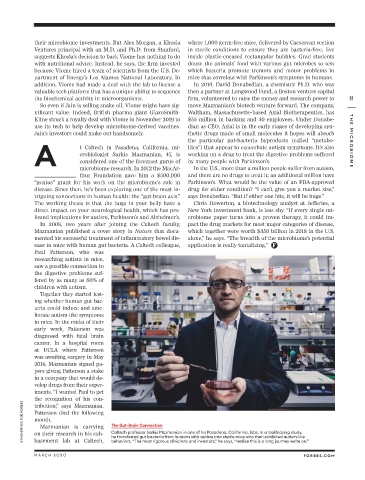
                                                 Caltech professor Sarkis Mazmanian in one of his Pasadena, California, labs. In a trailblazing study,
                on their research in his sub-
                                                 he transferred gut bacteria from humans with autism into sterile mice who then exhibited autism-like
                basement  lab  at  Caltech,

                M A R C H   2 0 2 0              behaviors. “The most rigorous clinicians and investors,” he says, “realize this is a long journey we’re on.”
                                                                                                                                    F O R B E S . C O M

