


Page 97 - Forbes - USA (March 2020)
P. 97
S                 omerville,  Massachusetts–based  Finch           cessfully treated, freeze-drying it and delivering the equiva-

                                 Therapeutics  is  one  of  the  most  prom-
                                                                                  lent of a fecal transplant in a single pill. It’s also working on
                                                                                  simpler drugs made from five to 10 key bacteria. It expects
                                 ising  startups  developing  microbiome
                                 drugs.  Cofounder  Mark  Smith,  33,  was  a     results from its first Phase 2 trial (which demonstrates ef-
                                 microbiol ogy  grad  student  at  MIT  when      ficacy) of the full-spectrum C. diff capsule by the end of the
                the 20-something C. diff patient begged him for help. “I had      second quarter of 2020.
                to tell him, I’m a microbiologist, not a doctor,” Smith says.       “Even if only a few of the microbiome therapies scientists
                  The  patient’s  ordeal  motivated  Smith  to  create  Open-     are working on come to fruition,” Smith says, “it will have a
                Biome, the equivalent of a public blood bank for human            huge impact on public health.”                                       95
                feces, while Smith was still at MIT in 2013. The Cambridge,
                Massachusetts, nonprofit, the first of its kind in the world,                          nother MIT Ph.D., Bernat Olle, 40, is run-         T
                has since supplied stool for more than 53,000 transplants         A                  ning Vedanta Biosciences, a nine-year-old          H
                in 1,200 hospitals and clinics.                                                      Cambridge, Massachusetts–based micro-              E

                  Inspired by the demand for transplants, Smith cofound-                             biome drug developer with $112 million             M
                                                                                                                                                        I
                ed for-profit Finch (named for the diverse group of finches                            in  funding,  including  $10  million  from        C
                                                                                                                                                        R
                Charles  Darwin  discovered  in  the  Galápagos  Islands)  in     the Bill & Melinda Gates Foundation. The Gates investment             O
                                                                                                                                                        B
                2016  to  develop  an  FDA-approved  C.  diff  pill.  Currently,   supports preclinical research at Vedanta aimed at develop-           I
                                                                                                                                                        O
                most doctors perform fecal transplants through a colonos-         ing a gut bacteria–derived drug that would prevent child              M
                copy, which can cost as much as $5,000. The procedure is          malnutrition in the developing world. Nearly 200 million              E
                not FDA-approved or reliably covered by insurance.                children under age 5 suffer from either wasting or stunting,
                  Smith and his 80 employees occupy two floors in an in-           resulting in at least 1.5 million deaths a year. “Malnourished
                dustrial  park  that  formerly  housed  administrative  offices   children  struggle  to  gain  weight  even  when  fed  enough,”
                and storage space for the Harvard Art Museums. Tall and           Olle says. “Emerging research suggests that this is because
                slender with piercing blue eyes, he welcomes the inevitable       their gut microbiota develop abnormally, and that benefi-
                jokes that come with being a human-feces entrepreneur. On         cial gut bacterial strains may help correct this imbalance.”
                Halloween he wore a poop-emoji costume (“I was a pooper             Vedanta also has two partnerships with big pharmaceuti-
                trooper”) to the office, where the copiers have names like        cal companies, including Bristol-Myers Squibb, to develop
                Squatty Potty and Magic Stool Bus.                                drugs aimed at boosting the effectiveness of immunotherapy
                  But he has raised serious capital. Venture funds have put       to treat melanoma and colorectal and gastric cancers. Like
                in $130 million, and Finch has a partnership with Tokyo-          Finch, Vedanta is developing a drug to treat recurrent C. diff.
                based pharma giant Takeda
                to  develop  drugs  for  ulcer-
                ative colitis and Crohn’s dis-
                ease,  which  together  have
                10  million  sufferers  world-
                wide. Finch is also working
                on an autism drug.
                  Traditionally,    scientists
                start  with  data  gathered
                through  experiments  on
                mice. Finch is taking a “hu-
                man-first”  approach,  skip-
                ping  the  rodents  and  ana-
                lyzing  the  stool  of  human
                patients  who  have  recov-
                ered  after  receiving  fecal
                transplants.  “We’re  looking
                at  what  works  in  patients
                and  figuring  out  how  to
                make  our  drugs  from  the
                top down,” Smith says. “It’s
           MICHAEL PRINCE FOR FORBES  Finch  is  extracting  what   Drugs From Bugs
                called reverse translation.”
                  For one of its C. diff drugs,


                Smith describes as the “full
                spectrum”  of  bacteria  in  a
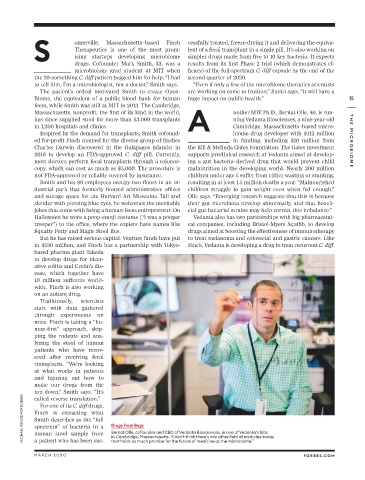
                                                 Bernat Olle, cofounder and CEO of Vedanta Biosciences, in one of Vedanta’s labs
                human  stool  sample  from
                                                 in Cambridge, Massachusetts. “I don’t think there’s any other field of medicine today
                a patient who has been suc-

                M A R C H   2 0 2 0              that holds as much promise for the future of medicine as the microbiome.”          F O R B E S . C O M

