


Page 148 - (DK Eyewitness) Travel Guide - The Netherlands
P. 148
146 A MSTERD A M
The Amsterdam School
The industrial revolution at the end of the 19th century
led to a boom in the growth of towns. New districts grew
around Amsterdam to accommodate the growing number
of factory workers. The architects of these districts, who
sought new elements for decorating building façades,
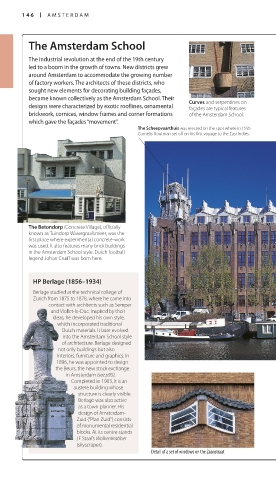
became known collectively as the Amsterdam School. Their Curves and serpentines on
designs were characterized by exotic rooflines, ornamental façades are typical features
brickwork, cornices, window frames and corner formations of the Amsterdam School.
which gave the façades “movement”.
The Scheepvaarthuis was erected on the spot where in 1595
Cornelis Houtman set off on his first voyage to the East Indies.
The Betondorp (Concrete Village), officially
known as Tuindorp Watergraafsmeer, was the
first place where experimental concrete-work
was used. It also features many brick buildings
in the Amsterdam School style. Dutch football
legend Johan Cruiff was born here.
HP Berlage (1856–1934)
Berlage studied at the technical college of
Zurich from 1875 to 1878, where he came into
contact with architects such as Semper
and Viollet-le-Duc. Inspired by their
ideas, he developed his own style,
which incorporated traditional
Dutch materials. It later evolved
into the Amsterdam School style
of architecture. Berlage designed
not only buildings but also
interiors, furniture and graphics. In
1896, he was appointed to design
the Beurs, the new stock exchange
in Amsterdam (see p95).
Completed in 1903, it is an
austere building whose
structure is clearly visible.
Berlage was also active
as a town planner. His
design of Amsterdam-
Zuid (“Plan Zuid”) consists
of monumental residential
blocks. At its centre stands
JF Staal’s Wolkenkrabber
(skyscraper). Michel de Klerk
Detail of a set of windows on the Zaanstraat (1884–1923)
146-147_EW_Netherlands.indd 146 16/01/17 12:04 pm

