


Page 206 - (DK Eyewitness) Travel Guide - The Netherlands
P. 206
204 WESTERN NE THERLANDS
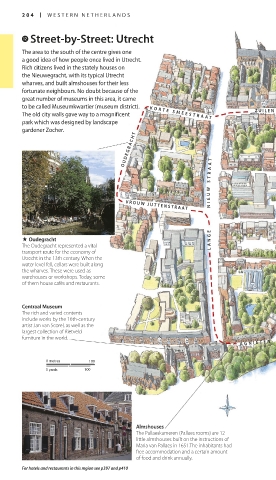
w Street-by-Street: Utrecht
The area to the south of the centre gives one
a good idea of how people once lived in Utrecht.
Rich citizens lived in the stately houses on
the Nieuwegracht, with its typical Utrecht
wharves, and built almshouses for their less
fortunate neighbours. No doubt because of the
great number of museums in this area, it came
to be called Museumkwartier (museum district). Z U I L E N S T R A AT
The old city walls gave way to a magnificent K O R T E S M E E S T R A A T
park which was designed by landscape
gardener Zocher.
O U D E G R A C H T
A A T
R
T
S
W
U
E
I
N
V R O U W J U T T E N S T R A AT
. Oudegracht A N G E
The Oudegracht represented a vital
transport route for the economy of L
Utrecht in the 13th century. When the
water level fell, cellars were built along
the wharves. These were used as
warehouses or workshops. Today, some
of them house cafés and restaurants.
Centraal Museum
The rich and varied contents
include works by the 16th-century
artist Jan van Scorel, as well as the
largest collection of Rietveld
furniture in the world. S T R A A T
A G N I E T E N
0 metres 100
0 yards 100
Almshouses
The Pallaeskameren (Pallaes rooms) are 12
little almshouses built on the instructions of
Maria van Pallaes in 1651.The inhabitants had
free accommodation and a certain amount
of food and drink annually.
For hotels and restaurants in this region see p397 and p410
204-205_EW_Netherlands.indd 204 16/01/17 12:05 pm
Eyewitness Travel LAYERS PRINTED:
Starsight template “UK” LAYER
(Source v2.7)
Date 24th April 2013
Size 125mm x 217mm

