


Page 210 - (DK Eyewitness) Travel Guide - The Netherlands
P. 210
208 WESTERN NE THERLANDS
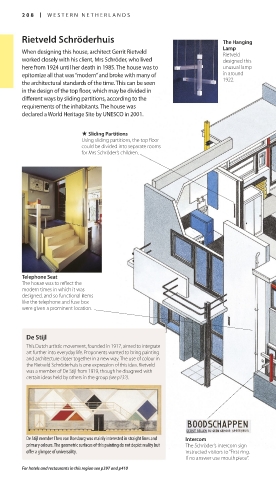
Rietveld Schröderhuis The Hanging
Lamp
When designing this house, architect Gerrit Rietveld Rietveld
worked closely with his client, Mrs Schröder, who lived designed this
here from 1924 until her death in 1985. The house was to unusual lamp
epitomize all that was “modern” and broke with many of in around
1922.
the architectural standards of the time. This can be seen
in the design of the top floor, which may be divided in
different ways by sliding partitions, according to the
requirements of the inhabitants. The house was
declared a World Heritage Site by UNESCO in 2001.
. Sliding Partitions
Using sliding partitions, the top floor
could be divided into separate rooms
for Mrs Schröder’s children.
Telephone Seat
The house was to reflect the
modern times in which it was
designed, and so functional items
like the telephone and fuse box
were given a prominent location.
De Stijl
This Dutch artistic movement, founded in 1917, aimed to integrate
art further into everyday life. Proponents wanted to bring painting
and architecture closer together in a new way. The use of colour in
the Rietveld Schröderhuis is one expression of this idea. Rietveld
was a member of De Stijl from 1919, though he disagreed with
certain ideas held by others in the group (see p132).
De Stijl member Theo van Doesburg was mainly interested in straight lines and Intercom
primary colours. The geometric surfaces of this painting do not depict reality but The Schröder’s intercom sign
offer a glimpse of universality. instructed visitors to “First ring.
If no answer use mouthpiece”.
For hotels and restaurants in this region see p397 and p410
208-209_EW_Netherlands.indd 208 16/01/17 11:54 am

