


Page 309 - (DK Eyewitness) Travel Guide - The Netherlands
P. 309
NOR THERN AND EASTERN NE THERLANDS 307
DRENTHE
Drenthe was once a free republic of farmers, and its inhab-
itants have always lived close to the land. Although the region
has no cities and few towns, the rural poverty that once
prevailed is no more, and tourists, especially those
interested in archaeology and nature, are arriving in
increasing numbers.
Drenthe, whose landscape is a product of from the Neolithic era; information about
the last Ice Age, has managed to keep time this period, with archaeological finds, is
at bay by holding on to its character, displayed in the museum at Borger. Other
reputed by the rest of the country to have museums in the region feature glass
been born of peat, gin and suspicion. blowing, artworks, natural history and
Moraines and megaliths dot the paper-cutting. Orvelte boasts a fine
countryside. The extensive woodland, open-air museum with Saxon farmhouses
heathland and peat bogs have a primeval and traditional crafts, while Dwingeloo
atmosphere, although this does not mean looks to the future at the Planetron
that there has been no human intervention. observatory and planetarium.
The top level of peat has been largely Visitors come to Drenthe for peace and
removed, while the traditional esdorps, the quiet after the rigours of city life. But this
local hamlets, have modern outskirts. does not mean there are no facilities –
However, peat moors and forests, ancient local centres such as Assen, Emmen and
burial mounds, canals, flocks of sheep and Hoogeveen are urbanized areas that grew
green fields are the principal features here. out of villages, and there is a variety of
There are more than 50 megaliths in hotels, guesthouses and restaurants
Drenthe, the remains of tombs dating throughout the region.
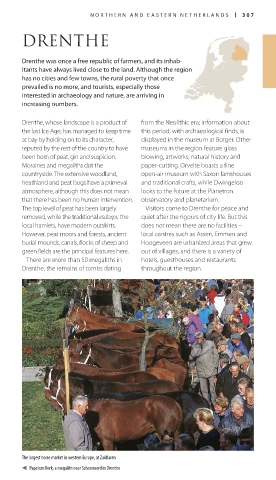
The largest horse market in western Europe, at Zuidlaren
Papeloze Kerk, a megalith near Schoonoord in Drenthe
306-307_EW_Netherlands.indd 307 16/01/17 12:06 pm

