


Page 26 - (DK Eyewitness) Back Roads Travel Guide - France
P. 26
24 BACK ROADS FRANCE

       Where to Eat

       One of the greatest pleasures of travelling in France is sampling
       the country’s regional dishes. Menus will nearly always feature
       local specialities that showcase the best and most typical produce
       of the area. Seasonality also prevails strongly in France, on menus
       as well as in markets. There is also a range of enticing shops where
       you can stock up with delicious items for an outdoor feast – the
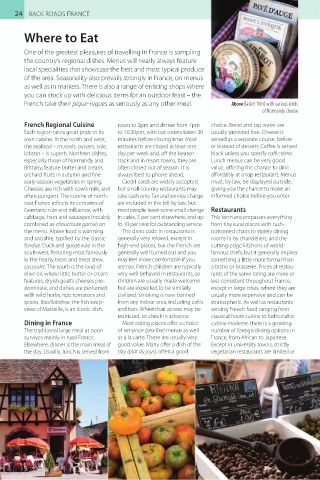
       French take their pique-niques as seriously as any other meal.  Above Basket filled with various kinds
                                                                    of Normandy cheese

       French Regional Cuisine  noon to 2pm and dinner from 7pm   choice. Bread and tap water are
       Each region takes great pride in its   to 10.30pm, with last orders taken 30   usually provided free. Cheese is
       own cuisine. In the north and west,   minutes before closing time. Most   served as a separate course, before
       the seafood – mussels, oysters, sole,   restaurants are closed at least one   or instead of dessert. Coffee is served
       lobster – is superb. Northern dishes,   day per week and, off the beaten   black unless you specify café crème.
       especially those of Normandy and   track and in resort towns, they are   Lunch menus can be very good
       Brittany, feature butter and cream,   often closed out of season. It is   value, offering the chance to dine
       orchard fruits in autumn and fine   always best to phone ahead.  afford ably at a top restaurant. Menus
       early-season vegetables in spring.   Credit cards are widely accepted   must, by law, be displayed outside,
       Cheeses are rich with cow’s milk, and   but small country restaurants may   giving you the chance to make an
       often pungent. The cuisine of north-  take cash only. Tax and service charge   informed choice before you enter.
       east France reflects its centuries of   are included in the bill by law, but
       Germanic rule and influence, with   most people leave some small change   Restaurants
       cabbage, ham and sausages (notably   in cafés, 5 per cent elsewhere, and up   This term encompasses everything
       combined as choucroute garnie) on   to 10 per cent for outstanding service.  from tiny rural places with rush-
       the menu. Alpine food is warming   The dress code in restaurants is   bottomed chairs to stately dining
       and sociable, typified by the classic   generally very relaxed, except in   rooms lit by chan deliers, and the
       fondue. Duck and goose rule in the   high-end places, but the French are   cutting-edge kitchens of world-
       southwest, featuring most famously   generally well turned out and you   famous chefs, but it generally implies
       in the hearty bean and meat stew,   may feel more comfortable if you    something a little more formal than
       cassoulet. The south is the land of   are too. French children are typically   a bistro or brasserie. Prices at restau-
       olive oil, where little butter or cream   very well behaved in restaurants, so   rants of the same rating are more or
       features, dryish goat’s cheeses pre-  children are usually made welcome   less consistent throughout France,
       dominate, and dishes are perfumed   but are expected to be similarly   except in large cities, where they are
       with wild herbs, ripe tomatoes and   civilized. Smoking is now banned   usually more expensive and can be
       spices. Bouillabaisse, the fish soup-  from any indoor area, including cafés   stratospheric. As well as restaurants
       stew of Marseille, is an iconic dish.  and bars. Wheelchair access may be   serving French food ranging from
                               restricted, so check in advance.   classical haute cuisine to fashionable
       Dining in France         Most eating places offer a choice   cuisine moderne, there is a growing
       The traditional large meal at noon   of set-price (prix fixe) menus as well   number of foreign dining options in
       survives mainly in rural France.   as à la carte. These are usually very   France, from African to Japanese.
       Elsewhere, dinner is the main meal of  good value. Many offer a dish of the   Except in university towns, strictly
       the day. Usually, lunch is served from   day (plat du jour), often a good   vegetarian restaurants are limited or

