


Page 106 - (DK Eyewitness) Travel Guide - Milan & The Lakes
P. 106
104 MILAN AREA B Y AREA
y Abbazia di Chiaravalle
French Cistercian monks began constructing this
church in 1150–60 and it was dedicated to the Virgin
Mary in 1221. The complex is a combination of French
Gothic and Lombard Romanesque, resulting in a
delightful example of Cistercian architecture. The
bell tower was added in 1349. The entrance is in the
16th-century tower flanked by two small churches.
In 1798 Napoleon suppressed the monastic order,
the monks were forced to leave and the abbey
deteriorated so much that in 1861 Bramante’s
15th-century cloister was demolished to make
room for a railway line. Restored and given back
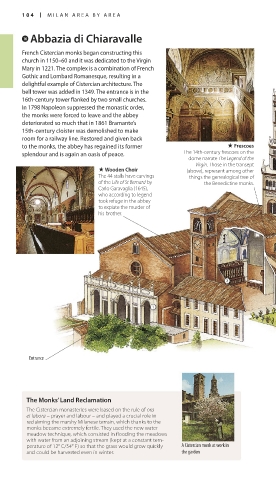
to the monks, the abbey has regained its former . Frescoes
splendour and is again an oasis of peace. The 14th-century frescoes on the
dome narrate The Legend of the
Virgin. Those in the transept
. Wooden Choir (above), represent among other
The 44 stalls have carvings things the genealogical tree of
of the Life of St Bernard by the Benedictine monks.
Carlo Garavaglia (1645),
who according to legend
took refuge in the abbey
to expiate the murder of
his brother.
Entrance
The Monks’ Land Reclamation
The Cistercian monasteries were based on the rule of ora
et labora – prayer and labour – and played a crucial role in
reclaiming the marshy Milanese terrain, which thanks to the
monks became extremely fertile. They used the new water
meadow technique, which consisted in flooding the meadows
with water from an adjoining stream (kept at a constant tem-
perature of 12° C/54° F) so that the grass would grow quickly A Cistercian monk at work in
and could be harvested even in winter. the garden
104-105_EW_Milan.indd 104 20/10/16 3:19 pm
Eyewitness Travel LAYERS PRINTED:
Starsight template “UK” LAYER
(Source v2.7)
Date 24th April 2013
Size 125mm x 217mm

