


Page 142 - (DK Eyewitness) Travel Guide - Milan & The Lakes
P. 142
140 THE LAKES OF NOR THERN IT AL Y
7 Verbania a small Romanesque
campanile and
* 31,000. n IAT, Corso Zanitello
6–8 (0323-55 66 69); Pro Loco, frescoes by Gerolamo
Viale delle Magnolie 1 (0323-55 76 Lanino and Camillo
76). ( antiques, Jul & Aug: 8pm– Procaccini (16th–
midnight Fri. 17th centuries).
Pallanza and Intra were E Museo
merged in 1939 to create the del Paesaggio
town of Verbania (capital of Via Ruga 44. Tel 0323-55
the Verbano-Cusio-Ossola 66 21. Open Apr–Oct:
province established in 1992). 10am–noon, 3:30–
The former, facing the Borromeo 6:30pm Tue–Sun.
gulf, is the seat of the municipal
government and has retained Environs
its medieval aspect and Y Giardini di
atmosphere. The latter Villa Taranto
dominates the promontory of Via Vittorio Veneto,
Castagnola and has a Baroque Pallanza. Tel 0323-55 66
and Neo-Classical flavour. Intra, 67. Open mid-Mar–Oct:
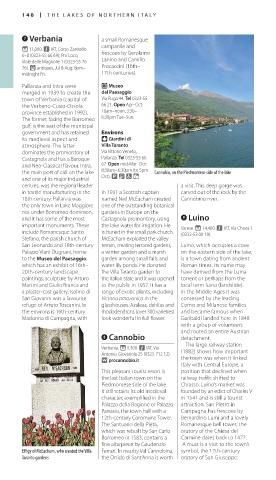
the main port of call on the lake 8:30am–6:30pm (to 5pm Cannobio, on the Piedmontese side of the lake
and one of its major industrial Oct). h & 7 =
centres, was the regional leader a visit. This deep gorge was
in textile manufacturing in the In 1931 a Scottish captain carved out of the rock by the
18th century. Pallanza was named Neil McEacharn created Cannobino river.
the only town in Lake Maggiore one of the outstanding botanical
not under Borromeo dominion, gardens in Europe on the
and it has some of the most Castagnola promontory, using 9 Luino
important monuments. These the lake water for irrigation. He Varese. * 14,400. n IAT, Via Chiara 1
include Romanesque Santo is buried in the small park church. (0332-53 00 19).
Stefano, the parish church of McEacharn exploited the valley
San Leonardo and 18th-century terrain, creating terraced gardens, Luino, which occupies a cove
Palazzo Viani Dugnani, home a winter garden and a marsh on the eastern side of the lake,
to the Museo del Paesaggio, garden among small falls and is a town dating from ancient
which has an exhibit of 16th– water lily ponds. He donated Roman times. Its name may
20th-century landscape the Villa Taranto garden to have derived from the Luina
paintings, sculpture by Arturo the Italian state and it was opened torrent or perhaps from the
Martini and Giulio Branca and to the public in 1952. It has a local term luina (landslide).
a plaster-cast gallery. Isolino di range of exotic plants, including In the Middle Ages it was
San Giovanni was a favourite Victoria amazonica in the contested by the leading
refuge of Arturo Toscanini. In glasshouses. Azaleas, dahlias and Como and Milanese families
the environs is 16th-century rhododendrons (over 300 varieties) and became famous when
Madonna di Campagna, with look wonderful in full flower. Garibaldi landed here in 1848
with a group of volunteers
and routed an entire Austrian
8 Cannobio detachment.
The large railway station
Verbania. * 5,300. n IAT, Via
Antonio Giovanola 25 (0323-712 12). (1882) shows how important
∑ procannobio.it the town was when it linked
Italy with Central Europe, a
This pleasant tourist resort is position that declined when
the last Italian town on the railway traffic shifted to
Piedmontese side of the lake. Chiasso. Luino’s market was
It still retains its old medieval founded by an edict of Charles V
character, exemplified in the in 1541 and is still a tourist
Palazzo della Ragione or Palazzo attraction. San Pietro in
Parrasio, the town hall with a Campagna has frescoes by
12th-century Commune Tower. Bernardino Luini and a lovely
The Santuario della Pietà, Romanesque bell tower; the
which was rebuilt by San Carlo oratory of the Chiesa del
Borromeo in 1583, contains a Carmine dates back to 1477.
fine altarpiece by Gaudenzio A must is a visit to the town’s
Effigy of McEacharn, who created the Villa Ferrari. In nearby Val Cannobina, symbol, the 17th-century
Taranto gardens the Orrido di Sant’Anna is worth oratory of San Giuseppe.
140-141_EW_Milan.indd 140 20/10/16 3:16 pm

