


Page 143 - (DK Eyewitness) Travel Guide - Milan & The Lakes
P. 143
LAKE M A GGIORE 141
visiting. A cable car goes
up to Sasso del Ferro, at
1,062 m (3,483 ft), behind
Laveno with fine views of
the lake, Monte Mottarone
and Monte Rosa.
q Santa Caterina
del Sasso Ballaro
Via Santa Caterina 13, Leggiuno.
Tel 0332-64 71 72. Open timings
vary, call ahead or check website
for details. 5 4:30pm hols. =
∑ santacaterinadelsasso.com
The harbour in Laveno, once an Austrian To get to this small monastery 14th–15th-century frescoes, Rocca
naval base perched on a steep rock di Angera
18 m (59 ft) above the lake,
0 Laveno you can either climb the 240 w Rocca di Angera
steps near Leggiuno or take
Varese. * 8,800. n IAT, Piazza Italia 2 Fortress and museum: Via Rocca,
(0332-66 87 85). the boat and enjoy the lovely Angera. Tel 0331-93 13 00.
views. The place was founded Open Apr–Oct: 9am–5:30pm daily.
The name of this town goes in the mid-12th century & 7 = 0
back to Titus Labienus, the by a local merchant. The
Roman general who was Dominicans arrived in 1230 A majestic fortress, probably
Caesar’s legate in Cisalpine and after numerous changes built over the ruins of an
Gaul. Laveno was important in fortune have since returned. ancient Roman fortification,
strategically because of its Over the centuries the original the Rocca once belonged
port, the only natural harbour building was enlarged and to the archbishops of Milan.
on Lake Maggiore. During rebuilt, as can be seen by the In the 13th century it was taken
their period of rule, the different archi tectural styles. over by the Visconti family and
Austrians moored the gun- The chapter at the entrance in 1449 was granted as a fief to
boats controlling the lake has important 14th–15th- the Borromeo family, who still
here. Today the town is the century frescoes, including own it. The Visconti building
main ferry point for the a Crucifixion with Armigers. has single and double lancet
Piedmontese shores. The In the second portico the windows and partly lies against
Ferrovie Nord railway linked 17th-century fresco, only the earlier castle tower. The
Laveno to Varese and Milan, partly preserved, represents frescoes in the halls are well
fostering commercial develop- a Dance of Death. The frescoes worth a look, especially those
ment, especially in the field inside the church were exe- in the Salone Gotico, with a
of ceramics with the founding cuted in the 16th century, and cycle of the Battles of Ottone
of well-known Società the Madonna and Child with Visconti against the Torriani
Ceramica Italiana Richard- Saints on the high altar dates (14th century). The vaults in
Ginori, in 1856. In the town from 1612. By the entrance this hall are decorated with
centre, the garden in the Villa porticoes there is a large wine the Visconti coat of arms, while
Frua (18th century) is worth press made in 1759. those in the other rooms have
geometric patterns and signs
of the Zodiac. The Borromeo
wing has frescoes removed
from Palazzo Borromeo in Milan
in 1946, with Aesop’s Fables
by the school of Michelino da
Besozzo (15th century). The
Rocca is used for art shows
and is also home to the Museo
della Bambola (Doll Museum)
in the Visconti wing, one of
the best of its kind in Europe,
created with the collection
of Princess Bona Borromeo.
Besides dolls and doll’s houses,
it contains books, games and
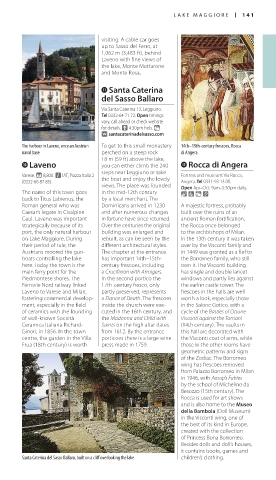
Santa Caterina del Sasso Ballaro, built on a cliff overlooking the lake children’s clothing.
140-141_EW_Milan.indd 141 20/10/16 3:16 pm

