


Page 63 - (DK Eyewitness) Travel Guide - Milan & The Lakes
P. 63
HIST ORIC CENTRE 61
form. Interesting works by following room has
Brueghel include The Mouse works by Francesco
with Roses and Allegories Cairo and Daniele
of Water and Fire, which Crespi, as well as
Napoleon removed and took Magdalen by Giulio
back to France. They were Cesare Procaccini.
later returned. Paintings by
The room known as Aula Magnasco, Magatti,
Leonardi is home to one of Fra Galgario and
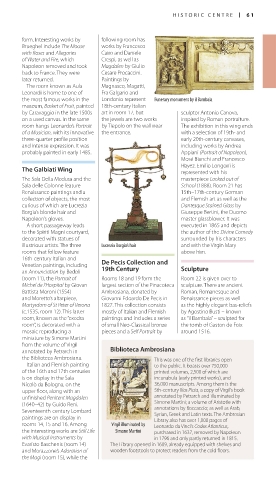
the most famous works in the Londonio represent Funerary monument by il Bambaia
museum, Basket of Fruit, painted 18th-century Italian
by Caravaggio in the late 1500s art in room 17, but sculptor Antonio Canova,
on a used canvas. In the same the jewels are two works inspired by Roman portraiture.
room hangs Leonardo’s Portrait by Tiepolo on the wall near The exhibition in this wing ends
of a Musician, with its innovative the entrance. with a selection of 19th- and
three-quarter profile position early 20th-century canvases,
and intense expression. It was including works by Andrea
probably painted in early 1485. Appiani (Portrait of Napoleon),
Mosé Bianchi and Francesco
Hayez. Emilio Longoni is
The Galbiati Wing represented with his
The Sala Della Medusa and the masterpiece Locked out of
Sala delle Colonne feature School (1888). Room 21 has
Renaissance paintings and a 15th–17th-century German
collection of objects, the most and Flemish art as well as the
curious of which are Lucrezia Dantesque Stained Glass by
Borgia’s blonde hair and Giuseppe Bertini, the Duomo
Napoleon’s gloves. master glassblower. It was
A short passageway leads executed in 1865 and depicts
to the Spiriti Magni courtyard, the author of the Divine Comedy
decorated with statues of surrounded by his characters
illustrious artists. The three Lucrezia Borgia’s hair and with the Virgin Mary
rooms that follow feature above him.
16th-century Italian and De Pecis Collection and
Venetian paintings, including
an Annunciation by Bedoli 19th Century Sculpture
(room 11), the Portrait of Rooms 18 and 19 form the Room 22 is given over to
Michel de l’Hospital by Giovan largest section of the Pinacoteca sculpture. There are ancient
Battista Moroni (1554) Ambrosiana, donated by Roman, Romanesque and
and Moretto’s altarpiece, Giovanni Edoardo De Pecis in Renaissance pieces as well
Martyr dom of St Peter of Verona 1827. This collection consists as the highly elegant bas-reliefs
(c.1535, room 12). This latter mostly of Italian and Flemish by Agostino Busti – known
room, known as the “exedra paintings and includes a series as “il Bambaia” – sculpted for
room”, is decorated with a of small Neo-Classical bronze the tomb of Gaston de Foix
mosaic reproducing a pieces and a Self Portrait by around 1516.
miniature by Simone Martini
from the volume of Virgil
annotated by Petrarch in Biblioteca Ambrosiana
the Biblioteca Ambrosiana. This was one of the first libraries open
Italian and Flemish painting to the public. It boasts over 750,000
of the 16th and 17th centuries printed volumes, 2,500 of which are
is on display in the Sala incunabula (early printed works), and
Nicolò da Bologna, on the 36,000 manuscripts. Among them is the
upper floor, along with an 5th-century Ilias Picta, a copy of Virgil’s book
unfinished Penitent Magdalen annotated by Petrarch and illuminated by
(1640–42) by Guido Reni. Simone Martini; a volume of Aristotle with
annotations by Boccaccio; as well as Arab,
Seventeenth-century Lombard Syrian, Greek and Latin texts. The Ambrosian
paintings are on display in Library also has over 1,000 pages of
rooms 14, 15 and 16. Among Virgil illuminated by Leonardo da Vinci’s Codex Atlanticus,
the interesting works are Still Life Simone Martini purchased in 1637, removed by Napoleon
with Musical Instruments by in 1796 and only partly returned in 1815.
Evaristo Baschenis (room 14) The Library opened in 1609, already equipped with shelves and
and Morazzone’s Adora tion of wooden footstools to protect readers from the cold floors.
the Magi (room 15), while the
060-061_EW_Milan.indd 61 20/10/16 3:19 pm

