


Page 59 - (DK Eyewitness) Travel Guide - Milan & The Lakes
P. 59
HIST ORIC CENTRE 57
r San Sepolcro y San Giorgio
Piazza San Sepolcro. Map 7 B1. q 1, 3 al Palazzo
Duomo. v 1, 2, 14. Open noon–2pm Piazza San Giorgio 2. Map 7 B1.
Mon–Fri. 5 5pm pre-hols; noon Tel 02-805 71 48. v 2, 14.
(winter), 5pm hols. ^ Open 7:30am–noon, 3:30–6pm daily.
5 8am Mon–Fri; 6pm pre-hols;
San Sepolcro was founded in 11am hols.
1030 in the area of the ancient
Roman Forum and rebuilt in Founded in 750, this church
1100 at the time of the second was named after an ancient
Crusade. The Neo-Roman esque Roman palatium which stood
façade was built in 1897, while here. It was radically changed
the interior is basically Baroque. in 1623 and 1800–21 by the
There are two terracotta groups architects Richini and Cagnola
by Agostino De Fondutis (16th respectively, and little remains
century): Christ Washing His of the original or Romanesque
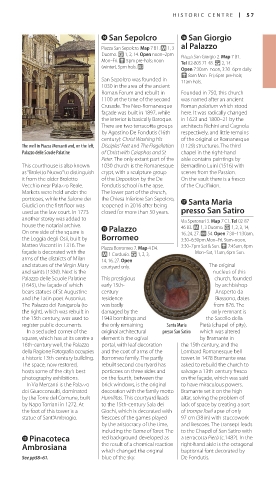
The well in Piazza Mercanti and, on the left, Disciples’ Feet and The Flagellation (1129) structures. The third
Palazzo delle Scuole Palatine of Christ with Caia phas and St chapel in the right-hand
Peter. The only extant part of the aisle contains paintings by
This courthouse is also known 1030 church is the Romanesque Bernardino Luini (1516) with
as “Broletto Nuovo” to distinguish crypt, with a sculpture group scenes from the Passion.
it from the older Broletto of the Deposition by the De On the vault there is a fresco
Vecchio near Palazzo Reale. Fondutis school in the apse. of the Crucifixion.
Markets were held under the The lower part of the church,
porticoes, while the Salone dei the Chiesa Inferiore San Sepolcro, u Santa Maria
Giudici on the first floor was reopened in 2016 after being
used as the law court. In 1773 closed for more than 50 years. presso San Satiro
another storey was added to Via Speronari 3. Map 7 C1. Tel 02-87
house the notarial archive. t Palazzo 46 83. q 1, 3 Duomo. v 1, 2, 3, 14,
On one side of the square is 16, 24, 27. @ 54. Open 7:30–11:30am,
the Loggia degli Osii, built by Borromeo 3:30–6:30pm Mon–Fri, 9am–noon,
Matteo Visconti in 1316. The Piazza Borromeo 7. Map 4 D4. 3:30–7pm Sat & Sun. 5 7:45am, 6pm
façade is decorated with the q 1 Cordusio. v 1, 2, 3, Mon–Sat, 11am, 6pm Sun.
arms of the districts of Milan 14, 16, 27. Open
and statues of the Virgin Mary courtyard only. The original
and saints (1330). Next is the nucleus of this
Palazzo delle Scuole Palatine This prestigious church, founded
(1645), the façade of which early 15th- by arch bishop
bears statues of St Augustine century Ansperto da
and the Latin poet Ausonius. residence Biassono, dates
The Palazzo dei Panigarola (to was badly from 876. The
the right), which was rebuilt in damaged by the only remnant is
the 15th century, was used to 1943 bombings and the Sacello della
register public documents. the only remaining Santa Maria Pietà (chapel of pity),
In a secluded corner of the original archi tectural presso San Satiro which was altered
square, which has at its centre a element is the ogival by Bramante in
16th-century well, the Palazzo portal, with leaf decoration the 15th century, and the
della Ragione Fotografia occupies and the coat of arms of the Lombard Romanesque bell
a historic 13th-century building. Borromeo family. The partly tower. In 1478 Bramante was
The space, now restored, rebuilt second court yard has asked to rebuild the church to
hosts some of the city’s best porticoes on three sides and salvage a 13th-century fresco
photography exhibitions. on the fourth, between the on the façade, which was said
In Via Mercanti is the Palazzo brick windows, is the original to have miraculous powers.
dei Giureconsulti, dominated decoration with the family motto Bramante set it on the high
by the Torre del Comune, built Humilitas. This courtyard leads altar, solving the problem of
by Napo Torriani in 1272. At to the 15th-century Sala dei lack of space by creating a sort
the foot of this tower is a Giochi, which is decorated with of trompe l’oeil apse of only
statue of Sant’Ambrogio. frescoes of the games played 97 cm (38 in) with stuccowork
by the aristocracy of the time, and frescoes. The transept leads
including the Game of Tarot. The to the Chapel of San Satiro with
e Pinacoteca red background developed as a terracotta Pietà (c.1482). In the
Ambrosiana the result of a chemical reaction right-hand aisle is the octagonal
baptismal font decorated by
which changed the original
See pp58–61. blue of the sky. De Fondutis.
056-057_EW_Milan.indd 57 20/10/16 3:15 pm

