


Page 71 - (DK Eyewitness) Travel Guide - Milan & The Lakes
P. 71
NOR THWEST MILAN 69
The art gallery houses works
in chronological order from
the mid-15th to the 18th
centuries. It begins in room
20, the former Falconry Tower
p, with 14th–15th-century
Italian paintings, while rooms
21 a and 22 s contain works
by Milanese artists such as
Vincenzo Foppa. Room 23 d
contains major works such
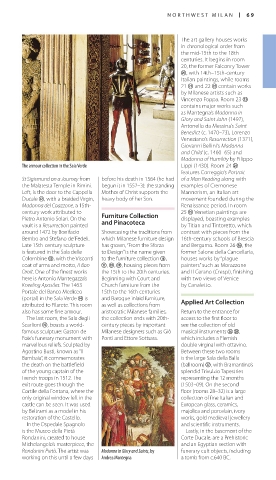
as Mantegna’s Madonna in
Glory and Saint John (1497),
Antonello da Messina’s Saint
Benedict (c. 1470–73), Lorenzo
Veneziano’s Resurrection (1371),
Giovanni Bellini’s Madonna
and Child (c. 1460–65) and
Madonna of Humility by Filippo
The armour collection in the Sala Verde Lippi (1430). Room 24 f
features Correggio’s Portrait
St Sigismund on a Journey from before his death in 1564 (he had of a Man Reading along with
the Malatesta Temple in Rimini. begun it in 1552–3): the standing examples of Cremonese
Left, is the door to the Cappella Mother of Christ supports the Mannerism, an Italian art
Ducale w, with a braided Virgin, heavy body of her Son. movement founded during the
Madonna del Coazzone, a 15th- Renaissance period. In room
century work attributed to 25 g Venetian paintings are
Pietro Antonio Solari. On the Furniture Collection displayed, boasting examples
and Pinacoteca
vault is a Resurrection painted by Titian and Tintoretto, which
around 1472 by Bonifacio Showcasing the traditions from contrast with pieces from the
Bembo and Stefano de’ Fedeli. which Milanese furniture design 16th-century schools of Brescia
Late 15th-century sculpture has grown, “From the Sforza and Bergamo. Room 26 h, the
is featured in the Sala delle to Design” is the name given former Salone della Cancellaria,
Colombine e, with the Visconti to the furniture collection y, houses works by “plague
coat of arms and motto, A Bon u, i, o, housing pieces from painters” such as Morazzone
Droit. One of the finest works the 15th to the 20th centuries. and Il Cerano (Crespi), finishing
here is Antonio Mantegazza’s Beginning with Court and with two views of Venice
Kneeling Apostles. The 1463 Church furniture from the by Canaletto.
Portale del Banco Mediceo 15th to the 16th centuries
(portal) in the Sala Verde r is and Baroque inlaid furniture, Applied Art Collection
attributed to Filarete. This room as well as collections from
also has some fine armour. aristocratic Milanese families, Return to the entrance for
The last room, the Sala degli the collection ends with 20th- access to the first floor to
Scarlioni t, boasts a world- century pieces by important see the collection of old
famous sculpture: Gaston de Milanese designers such as Giò musical instruments m .,
Foix’s funerary monument with Ponti and Ettore Sottsass. which includes a Flemish
marvellous reliefs. Sculpted by double virginal with ottavino.
Agostino Busti, known as “Il Between these two rooms
Bambaia”, it commemorates is the large Sala della Balla
the death on the battlefield (ballroom) ,, with Bramantino’s
of the young captain of the splendid Trivulzio Tapestries
French troops in 1512. The representing the 12 months
exit route goes through the (1503–09). On the second
Cortile della Fon tana, where the floor (rooms 28–32) is a large
only original window left in the collection of fine Italian and
castle can be seen. It was used European glass, ceramics,
by Beltrami as a model in his majolica and porcelain, ivory
restoration of the Castello. works, gold medieval jewellery
In the Ospedale Spagnolo and scientific instruments.
is the Museo della Pietà Lastly, in the basement of the
Rondanini, created to house Corte Ducale, are a Prehistoric
Michelangelo’s masterpiece, the and an Egyptian section with
Rondanini Pietà. The artist was Madonna in Glory and Saints, by funerary cult objects, including
working on this until a few days Andrea Mantegna a tomb from c.640 BC.
068-069_EW_Milan.indd 69 20/10/16 3:19 pm

