


Page 90 - (DK Eyewitness) Top 10 Travel Guide - Tokyo
P. 90
88  ❯❯  Tokyo Area by Area


                               RICKSHAWS
                               The jinrikisha (rickshaw) is said to have
                               been invented in Japan in 1869. Yosuke
                               Izumi’s workshop produced the prototype,
                               a great transportation innovation in
                               Tokyo’s narrow roads. Four years later, there
                               were over 34,000 registered rickshaws in
                               the city, still a common sight until World
                               War II. Beautifully lacquered rickshaws
                               have made a comeback in tourist spots
                               such as Asakusa. Expect to pay around
     Artisan at work, Edo-Shitamachi   ¥5,000 for a 15-minute ride.
     Traditional Crafts Museum
         Edo-Shitamachi
     5                        times. Erected even earlier, the
         Traditional Crafts
                              nearby 1618 Niten-mon gate
     Museum                   remains completely intact, a
     MAP R2  •  2-22-13 Asakusa, Taito-ku    miraculous survivor of earthquakes,
     •  3842-1990  •  Open 10am–8pm  typhoons, and air raids (see pp14–15).
     Also known as Gallery Takumi, this
                                  Hanayashiki
     museum was set up to preserve and   7
     promote local craft industries and   MAP R1  •  2-28-1 Asakusa,
     techniques dating from the Edo   Taito-ku  •  3842-8780  •  Open
     period. Over 300 displays represent   10am–6pm daily  •  Adm
     50 different traditional crafts, with   Once part of an aristocratic
     demonstrations on weekends.   residence to the west of Senso-ji
                              temple, the Hanayashiki gardens
         Senso-ji Temple
     6                        were opened in the Asakusa Rokku
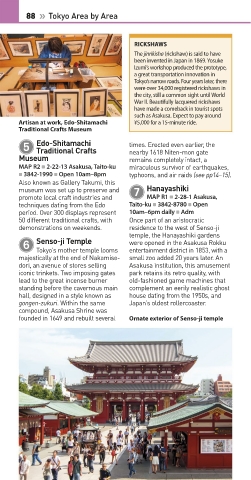
         Tokyo’s mother temple looms
                              entertainment district in 1853, with a
     majestically at the end of Nakamise-  small zoo added 20 years later. An
     dori, an avenue of stores selling   Asakusa institu tion, this amuse ment
     iconic trinkets. Two imposing gates   park retains its retro quality, with
     lead to the great incense burner   old-fashioned game machines that
     standing before the cavernous main   complement an eerily realistic ghost
     hall, designed in a style known as   house dating from the 1950s, and
     gongen-zukuri. Within the same   Japan’s oldest rollercoaster.
     compound, Asakusa Shrine was
     founded in 1649 and rebuilt several   Ornate exterior of Senso-ji temple


 086-089_Top_10_Tokyo.indd   88                       15/11/2016   12:26

