


Page 103 - (DK Eyewitness) Travel Guide - France
P. 103
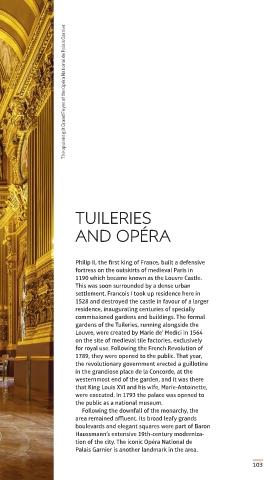
The opulent gilt Grand Foyer of the Opéra National de Palais Garnier


                     TUILERIES

                    AND OPÉRA


                    Philip II, the first king of France, built a defensive
                    fortress on the outskirts of medieval Paris in
                    1190 which became known as the Louvre Castle.
                    This was soon surrounded by a dense urban
                    settlement. Francois I took up resi dence here in
                    1528 and destroyed the castle in favour of a larger
                    residence, inaugurating centuries of specially
                    commissioned gardens and buildings. The formal
                    gardens of the Tuileries, running alongside the
                    Louvre, were created by Marie de’ Medici in 1564
                    on the site of medieval tile factories, exclu sively
                    for royal use. Following the French Revolution of
                    1789, they were opened to the public. That year,
                    the revolutionary government erected a guillotine
                    in the grandiose place de la Concorde, at the
                    westernmost end of the garden, and it was there
                    that King Louis XVI and his wife, Marie-Antoinette,
                    were executed. In 1793 the palace was opened to
                    the public as a national museum.
                      Following the downfall of the monarchy, the
                    area remained affluent. Its broad leafy grands
                    boulevards and elegant squares were part of Baron
                    Haussmann’s extensive 19th-century moderniza-
                    tion of the city. The iconic Opéra National de
                    Palais Garnier is another landmark in the area.
                                                                  103


   102-103_EW_France.indd   103                              29/01/2019   15:05

