


Page 113 - (DK Eyewitness) Travel Guide - France
P. 113
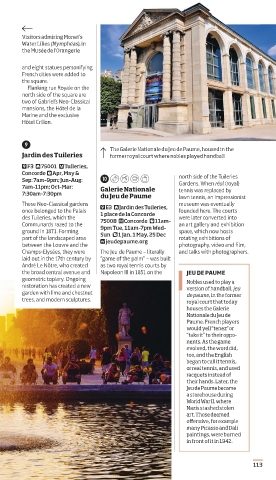
Visitors admiring Monet’s
Water Lilies (Nymphéas), in
the Musée de l’Orangerie
and eight statues personifying
French cities were added to
the square.
Flanking rue Royale on the
north side of the square are
two of Gabriel’s Neo-Classical
mansions, the Hôtel de la
Marine and the exclusive
Hôtel Crillon.
9 The Galerie Nationale du Jeu de Paume, housed in the
Jardin des Tuileries former royal court where nobles played handball
F3 ⌂ 75001 q Tuileries,
Concorde # Apr, May &
Sep: 7am–9pm; Jun–Aug: 10 "' - = north side of the Tuileries
7am–11pm; Oct–Mar: Galerie Nationale Gardens. When réal (royal)
tennis was replaced by
7:30am–7:30pm du Jeu de Paume lawn tennis, an Impressionist
These Neo-Classical gardens E3 ⌂ Jardin des Tuileries, museum was eventually
once belonged to the Palais 1 place de la Concorde founded here. The courts
des Tuileries, which the 75008 q Concorde # 11am– were later converted into
Communards razed to the 9pm Tue, 11am–7pm Wed– an art gallery and exhibition
ground in 1871. Forming Sun ¢ 1 Jan, 1 May, 25 Dec space, which now hosts
part of the landscaped area ∑ jeudepaume.org rotating exhibitions of
between the Louvre and the photography, video and film,
Champs-Elysées, they were The Jeu de Paume – literally and talks with photographers.
laid out in the 17th century by “game of the palm” – was built
André Le Nôtre, who created as two royal tennis courts by
the broad central avenue and Napoleon III in 1851 on the JEU DE PAUME
geometric topiary. Ongoing Nobles used to play a
restoration has created a new version of handball, jeu
garden with lime and chestnut de paume, in the former
trees, and modern sculptures. royal court that today
houses the Galerie
Nationale du Jeu de
Paume. French players
would yell “tenez” or
“take it” to their oppo
nents. As the game
evolved, the word did,
too, and the English
began to call it tennis,
or real tennis, and used
racquets instead of
their hands. Later, the
Jeu de Paume became
a storehouse during
World War II, where
Nazis stashed stolen
art. Those deemed
offensive, for example
many Picasso and Dalí
paintings, were burned
in front of it in 1942.
113
112-113_EW_France.indd 113 29/01/2019 15:05

