


Page 109 - (DK Eyewitness) Travel Guide - France
P. 109
Must See
                           DECORATIVE ARTS

                           The Louvre has well over    The French crown jewels
                           8,000 “decorative art”   include the coronation crowns
                           objects, including jewellery,   of Louis XV and Napoleon,
                            silver and glassware,   and the Regent, one of the
                            bronzes, porce lain,   purest diamonds in the world.
                             snuffboxes and armour.     The large collection of
                             Many of these precious   French furniture ranges from
                             objects are from the   the 16th to the 19th centuries.
                            Abbey of St-Denis, where   On display are important
                            the kings of France were   pieces by prominent furniture-
                           buried. The treasures include     makers such as André-Charles
                           a serpentine stone plate from   Boulle, who was cabinet-
                           the 1st century AD with a    maker to Louis XIV.
                           9th-century border of gold     In 2012, the Islamic Art
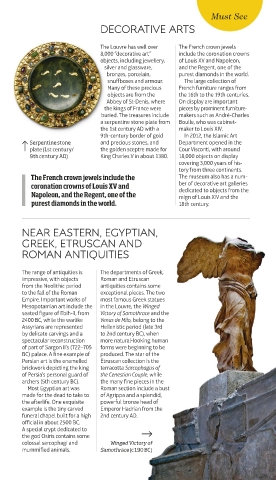
         Serpentine stone    and precious stones, and    Department opened in the
         plate (1st century/   the golden sceptre made for   Cour Visconti, with around
         9th century AD)   King Charles V in about 1380.   18,000 objects on display
                                               covering 3,000 years of his-
                                               tory from three continents.
         The French crown jewels include the   The museum also has a num-
         coronation crowns of Louis XV and     ber of deco rative art gal leries
         Napoleon, and the Regent, one of the   dedicated to objects from the
                                               reign of Louis XIV and the
         purest diamonds in the world.         18th century.


       NEAR EASTERN, EGYPTIAN,
       GREEK, ETRUSCAN AND
       ROMAN ANTIQUITIES

       The range of antiquities is   The departments of Greek,
       impressive, with objects    Roman and Etruscan
       from the Neolithic peri od    antiquities contains some
       to the fall of the Roman   exceptional pieces. The two
       Empire. Impor tant works of   most famous Greek statues
       Mesopotamian art include the   in the Louvre, the Winged
       seated figure of Ebih-iI, from   Victory of Samothrace and the
       2400 BC, while the warlike   Venus de Milo, belong to the
       Assyrians are represented    Hellenistic period (late 3rd
       by delicate carvings and a   to 2nd century BC), when
       spectacular recon struction    more natural-looking human
       of part of Sargon II’s (722–705   forms were beginning to be
       BC) palace. A fine example of   produced. The star of the
       Persian art is the enamelled   Etruscan collection is the
       brickwork depicting the king   terracotta Sarcophagus of
       of Persia’s personal guard of   the Cenestian Couple, while
       archers (5th century BC).   the many fine pieces in the
         Most Egyptian art was   Roman section include a bust
       made for the dead to take to   of Agrippa and a splendid,
       the afterlife. One exquisite   powerful bronze head of
       example is the tiny carved   Emperor Hadrian from the
       funeral chapel built for a high   2nd century AD.
       official in about 2500 BC.
       A special crypt dedicated to
       the god Osiris contains some
       colossal sarcophagi and   Winged Victory of
       mummified animals.  Samothrace (c 190 BC)


   108-109_EW_France.indd   109                              29/01/2019   15:05

