


Page 455 - (DK Eyewitness) Travel Guide - France
P. 455
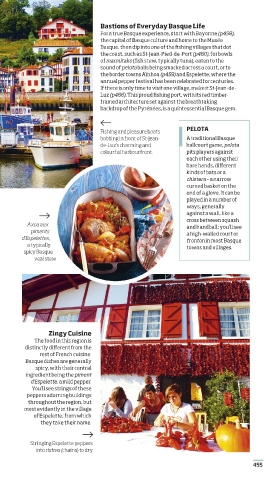
Bastions of Everyday Basque Life
                           For a true Basque experience, start with Bayonne (p458),
                           the capital of Basque culture and home to the Musée
                           Basque, then dip into one of the fishing villages that dot
                           the coast, such as St-Jean-Pied-de-Port (p460), for bowls
                           of marmitako (fish stew, typically tuna), eaten to the
                           sound of pelota balls being smacked across a court, or to
                           the border towns Aïnhoa (p459) and Espelette, where the
                           annual pepper festival has been celebrated for centuries.
                           If there is only time to visit one village, make it St-Jean-de-
                           Luz (p466). This proud fishing port, with its red timber-
                           framed architecture set against the breathtaking
                           backdrop of the Pyrénées, is a quintessential Basque gem.

                           Fishing and pleasure boats   PELOTA
                           bobbing in front of St-Jean-   A traditional Basque
                           de-Luz’s charming and   ballcourt game, pelota
                           colourful harbourfront.   pits players against
                                                 each other using their
                                                 bare hands, different
                                                 kinds of bats or a
                                                 chistera – a narrow
                                                 curved basket on the
                                                 end of a glove. It can be
                                                 played in a number of
                                                 ways, generally
                                                 against a wall, like a
                                                 cross between squash
        Axoa aux                                 and handball; you’ll see
         piments                                 a high-walled court or
       d’Espelettes,                             fronton in most Basque
        a typically                              towns and villages.
       spicy Basque
          veal stew


              Zingy Cuisine
          The food in this region is
       distinctly different from the
           rest of French cuisine.
        Basque dishes are generally
          spicy, with their central
        ingredient being the piment
         d’Espelette, a mild pepper.
         You’ll see strings of these
        peppers adorning buildings
        throughout the region, but
       most evidently in the village
          of Espelette, from which
           they take their name.

         Stringing Espelette peppers
          into ristras (chains) to dry
                                                                  455


   454-455_EW_France.indd   455                              30/01/2019   12:41

