


Page 83 - (DK Eyewitness) Travel Guide - France
P. 83
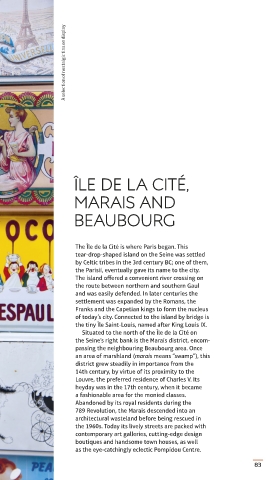
A selection of nostalgic tins on display


                      ÎLE DE LA CITÉ,

                      MARAIS AND

                      BEAUBOURG


                    The Île de la Cité is where Paris began. This
                    tear-drop-shaped island on the Seine was settled
                    by Celtic tribes in the 3rd century BC; one of them,
                    the Parisii, eventually gave its name to the city.
                    The island offered a convenient river crossing on
                    the route between northern and southern Gaul
                    and was easily defended. In later centuries the
                    settlement was expanded by the Romans, the
                    Franks and the Capetian kings to form the nucleus
                    of today’s city. Connected to the island by bridge is
                    the tiny Île Saint-Louis, named after King Louis IX.
                      Situated to the north of the Île de la Cité on
                    the Seine’s right bank is the Marais district, encom-
                    passing the neighbouring Beaubourg area. Once
                    an area of marshland (marais means “swamp”), this
                    district grew steadily in importance from the
                    14th century, by virtue of its proximity to the
                    Louvre, the preferred residence of Charles V. Its
                    heyday was in the 17th century, when it became
                    a fashion able area for the monied classes.
                    Abandoned by its royal residents during the
                    789 Revolution, the Marais descended into an
                    architectural wasteland before being rescued in
                    the 1960s. Today its lively streets are packed with
                    contemporary art galleries, cutting-edge design
                    boutiques and handsome town houses, as well
                    as the eye-catchingly eclectic Pompidou Centre.
                                                                  83


   082-083_EW_France.indd   83                               22/02/2019   16:21

