


Page 86 - (DK Eyewitness) Travel Guide - France
P. 86
1 "'
NOTRE-DAME
H5 ⌂ Pl du Parvis Notre-Dame q Cité @ 21, 38, 47, 58, 70, 72, 81, 82
x Notre-Dame # 8am–6:30pm Mon–Fri, 8am–7:15pm Sat & Sun ¢ 1 Jan,
1 May, 25 Dec ∑ notredamedeparis.fr
EXPERIENCE Paris: Île de la Cité, Marais and Beaubourg
No other building is more associated with the history of Paris than
Notre-Dame (Our Lady). The “heart” of the country, both geographically
and spiritually, the cathedral rises majestically at the eastern end of the
Île de la Cité. A Gothic masterpiece, it is famed for its stained glass and
rose windows, towers, flying buttresses and gargoyles.
Notre-Dame is built on the site of a Roman
temple. After Pope Alexander III laid the first
stone in 1163, an army of architects and crafts-
men toiled for 170 years to realize Bishop
Maurice de Sully’s magnificent design. At
the time it was finished, in about 1334, it
was 130 m (430 ft) long and featured flying
buttresses, a large transept, a deep choir
and 69-m- (228-ft-) high towers.
Within the cathedral’s hallowed walls,
kings and emperors were crowned and royal
Crusaders were blessed. But Notre-Dame was
also the scene of turmoil. Revolutionaries
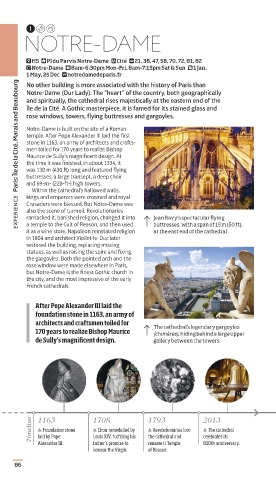
ransacked it, banished religion, changed it into Jean Ravy’s spectacular flying
a temple to the Cult of Reason, and then used buttresses, with a span of 15 m (50 ft),
it as a wine store. Napoléon reinstated religion at the east end of the cathedral
in 1804 and architect Viollet-le-Duc later
restored the building, replacing missing
statues, as well as raising the spire and fixing
the gargoyles. Both the pointed arch and the
rose window were made elsewhere in Paris,
but Notre-Dame is the finest Gothic church in
the city, and the most impressive of the early
French cathedrals.
After Pope Alexander III laid the
foundation stone in 1163, an army of
architects and craftsmen toiled for
170 years to realize Bishop Maurice The cathedral’s legendary gargoyles
(chimères), hiding behind a large upper
de Sully’s magnificent design. gallery between the towers
Timeline 1163 1708 1793 2013
▲ Foundation stone
▲ Choir remodelled by
▲ The cathedral
▲ Revolutionaries loot
Louis XIV, fulfilling his
the cathedral and
celebrates its
laid by Pope
father’s promise to
Alexander III.
of Reason.
honour the Virgin. rename it Temple 850th anniversary.
86
086-087_EW_France.indd 86 22/02/2019 16:21
EW Must-see template v2.1 – 18th October 2018
Fonts: Aptifer Sans LT Pro, Posterama Text, Soho Gothic
Pro, Soho Pro, ITC Caslon 224

