


Page 60 - (DK Eyewitness) Travel Guide - Southwest USA & National Parks
P. 60
58 ARIZ ONA INTRODUCING ARIZ ONA 59
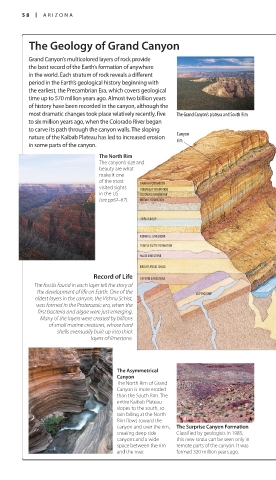
The Geology of Grand Canyon
The Colorado River
Grand Canyon’s multicolored layers of rock provide About 5 million years
the best record of the Earth’s formation of anywhere ago the Colorado River
changed its course.
in the world. Each stratum of rock reveals a different According to one theory,
period in the Earth’s geological history beginning with it was encompassed by
the earliest, the Precambrian Era, which covers geological another, smaller river
time up to 570 million years ago. Almost two billion years that flowed through the
Kaibab Plateau. The
of history have been recorded in the canyon, although the force of the combined
most dramatic changes took place relatively recently, five The Grand Canyon’s plateau and South Rim waters carved out the
to six million years ago, when the Colorado River began deep Grand Canyon.
to carve its path through the canyon walls. The sloping
nature of the Kaibab Plateau has led to increased erosion Canyon The South Rim of the
rim
in some parts of the canyon. canyon lies closer to the Fish plate
Colorado River than to fossils are
The North Rim the North Rim. found in
The canyon’s size and the Kaibab
beauty are what Vishnu Schist Formation.
make it one
of the most KAIBAB FORMATION Colorado
visited sights TOROWEAP FORMATION River
in the US COCONINO SANDSTONE
(see pp62–67). HERMIT FORMATION
Seedfern
leaf fossils
are found in
SUPAI GROUP
the Hermit
Formation layer.
REDWALL LIMESTONE
TEMPLE BUTTE FORMATION
MUAV LIMESTONE
Temple
Butte
BRIGHT ANGEL SHALE
Formation
Record of Life TAPEATS SANDSTONE contains fossils
The fossils found in each layer tell the story of of marine
the development of life on Earth. One of the SUPERGROUP creatures.
oldest layers in the canyon, the Vishnu Schist,
was formed in the Proterozoic era, when the
first bacteria and algae were just emerging. Trilobite fossil of
Many of the layers were created by billions the type found
of small marine creatures, whose hard in the canyon’s
shells eventually built up into thick Bright Angel
layers of limestone. Shale layer.
How the Canyon was Formed
The Asymmetrical
Canyon While the Colorado River accounts for the canyon’s depth,
The North Rim of Grand its width and formations are the work of even greater forces.
Canyon is more eroded Wind rushing through the canyon erodes the limestone and
than the South Rim. The sandstone a few grains at a time. Rain pouring over the
entire Kaibab Plateau canyon rim cuts deep side canyons through the softer rock.
slopes to the south, so Perhaps the greatest canyon-building force is ice. Water from
rain falling at the North rain and snowmelt works into cracks in the rock. When frozen,
Rim flows toward the it expands, forcing the rock away from the canyon walls.
canyon and over the rim, The Surprise Canyon Formation The layers vary in hardness. Soft layers erode quickly into
creating deep side Classified by geologists in 1985, sloped faces. Harder rock resists erosion, leaving sheer
canyons and a wide this new strata can be seen only in vertical faces.
space between the rim remote parts of the canyon. It was The Colorado River winding through the canyon
and the river. formed 320 million years ago.
058-059_EW_SW_USA.indd 58 28/11/17 12:39 PM 058-059_EW_SW_USA.indd 59 28/11/17 12:39 PM
Eyewitness Travel LAYERS PRINTED:
Feature template “UK” LAYER
(SourceReport v1.3)
Date 18th October 2012
Size 125mm x 217mm

