


Page 61 - (DK Eyewitness) Travel Guide - Southwest USA & National Parks
P. 61
INTRODUCING ARIZ ONA 59
The Colorado River
About 5 million years
ago the Colorado River
changed its course.
According to one theory,
it was encompassed by
another, smaller river
that flowed through the
Kaibab Plateau. The
force of the combined
waters carved out the
deep Grand Canyon.
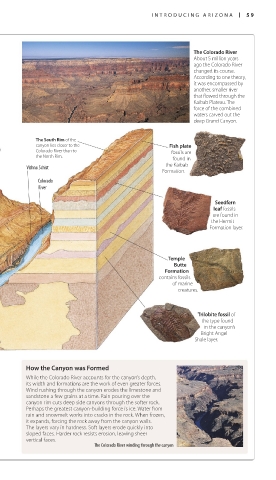
The South Rim of the
canyon lies closer to the Fish plate
Colorado River than to fossils are
the North Rim. found in
Vishnu Schist the Kaibab
Formation.
Colorado
River
Seedfern
leaf fossils
are found in
the Hermit
Formation layer.
Temple
Butte
Formation
contains fossils
of marine
creatures.
Trilobite fossil of
the type found
in the canyon’s
Bright Angel
Shale layer.
How the Canyon was Formed
While the Colorado River accounts for the canyon’s depth,
its width and formations are the work of even greater forces.
Wind rushing through the canyon erodes the limestone and
sandstone a few grains at a time. Rain pouring over the
canyon rim cuts deep side canyons through the softer rock.
Perhaps the greatest canyon-building force is ice. Water from
rain and snowmelt works into cracks in the rock. When frozen,
it expands, forcing the rock away from the canyon walls.
The layers vary in hardness. Soft layers erode quickly into
sloped faces. Harder rock resists erosion, leaving sheer
vertical faces.
The Colorado River winding through the canyon
058-059_EW_SW_USA.indd 59 28/11/17 12:39 PM

