


Page 18 - All About History - Issue 54-17
P. 18
AZTECS


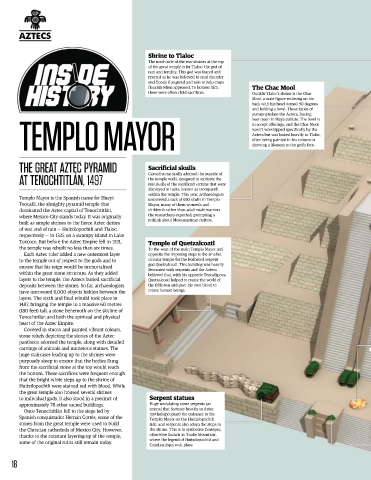
                                                     Shrine to Tlaloc
                                                     The north side of the two shrines at the top
                                                     of the great temple is for Tlaloc, the god of
                                                     rain and fertility. This god was feared and
                                                     revered as he was believed to send thunder
                                                     and floods if angered and rain to help crops
                                                     flourish when appeased. To honour him,   The Chac Mool
                                                     there were often child sacrifices.   Outside Tlaloc’s shrine is the Chac
                                                                                          Mool, a male figure reclining on his
                                                                                          back with his head turned 90 degrees
                                                                                          and holding a bowl. These types of
                                                                                          statues predate the Aztecs, having
        TEMPLO MAYOR                                                                      to accept offerings, and the Chac Mool
                                                                                          been seen in Maya culture. The bowl is
                                                                                          wasn’t worshipped specifically by the
                                                                                          Aztecs but was linked heavily to Tlaloc,
                                                                                          often being painted in his colours or
                                                                                          showing a likeness to the god’s face.


        THE GREAT AZTEC PYRAMID                      Sacrificial skulls

                                                     Carved stone skulls adorned the outside of
        AT TENOCHTITLÁN, 1497                        the temple walls, designed to replicate the
                                                     real skulls of the sacrificed victims that were
                                                     displayed in racks, known as tzompantli,
                                                     within the temple. This year, archaeologists
        Templo Mayor is the Spanish name for Hueyi   uncovered a rack of 650 skulls in Templo
        Teocalli, the almighty pyramid temple that   Mayor, many of them women’s and
        dominated the Aztec capital of Tenochtitlán,   children’s rather than adult male warriors
        where Mexico City stands today. It was originally   the researchers expected, prompting a
                                                     rethink about Mesoamerican culture.
        built as simple shrines to the fierce Aztec deities
        of war and of rain — Huitzilopochtli and Tlaloc,
        respectively — in 1325 on a swampy island in Lake
        Toxcoco. But before the Aztec Empire fell in 1521,   Temple of Quetzalcoatl
        the temple was rebuilt no less than six times.  To the west of the main Templo Mayor and
          Each Aztec ruler added a new outermost layer   opposite the imposing steps is the smaller,
        to the temple out of respect to the gods and to   circular temple for the feathered serpent
                                                     god Quetzalcoatl. This building was heavily
        ensure that his reign would be immortalised
                                                     decorated with serpents and the Aztecs
        within the great stone structure. As they added   believed that, with his opposite Tezcatlipoca,
        layers to the temple, the Aztecs buried sacrificial   Quetzalcoatl helped to create the world of
        deposits between the stones. So far, archaeologists   the fifth sun and gave his own blood to
        have uncovered 6,000 objects hidden between the   create human beings.
        layers. The sixth and final rebuild took place in
        1487, bringing the temple to a massive 60 metres
        (180 feet) tall, a stone behemoth on the skyline of
        Tenochtitlán and both the spiritual and physical
        heart of the Aztec Empire.
          Covered in stucco and painted vibrant colours,
        stone reliefs depicting the stories of the Aztec
        pantheon adorned the temple, along with detailed
        carvings of animals and numerous statues. The
        huge staircases leading up to the shrines were
        purposely steep to ensure that the bodies flung
        from the sacrificial stone at the top would reach
        the bottom. These sacrifices were frequent enough
        that the bright white steps up to the shrine of
        Huitzilopochtli were stained red with blood. While
        the great temple also housed several shrines
        to individual gods, it also stood in a precinct of   Serpent statues
        approximately 78 other sacred buildings.      Huge undulating stone serpents (an
                                                      animal that features heavily in Aztec
          Once Tenochtitlán fell to the siege led by
                                                      mythology) guard the entrance to the
        Spanish conquistador Hernán Cortés, some of the   Templo Mayor on the Huitzilopochtli
        stones from the great temple were used to build   side, and serpents also adorn the steps to
        the Christian cathedrals of Mexico City. However,   the shrine. This is to symbolise Coatepec,
        thanks to the constant layering-up of the temple,   otherwise known as ‘Snake Mountain’,
                                                      where the legend of Huitzilopochtli and
        some of the original ruins still remain today.
                                                      Coyolxauhqui took place.
     18

