


Page 62 - All About History - Issue 54-17
P. 62
Greatest Battles


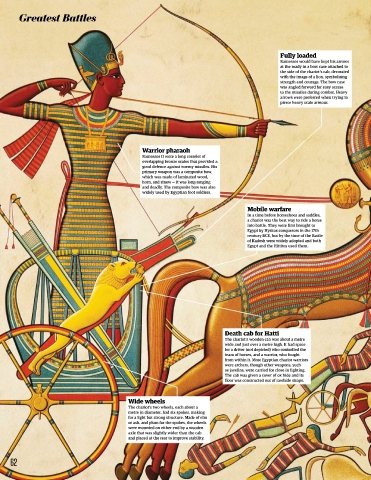
                                                                                                    Fully loaded
                                                                                                    Ramesses would have kept his arrows
                                                                                                    at the ready in a bow case attached to
                                                                                                    the side of the chariot’s cab, decorated
                                                                                                    with the image of a lion, symbolising
                                                                                                    strength and courage. The bow case
                                                                                                    was angled forward for easy access
                                                                                                    to the missiles during combat. Heavy
                                                                                                    arrows were preferred when trying to
                                                                                                    pierce heavy scale armour.


                                                   Warrior pharaoh
                                                   Ramesses II wore a long corselet of
                                                   overlapping bronze scales that provided a
                                                   good defence against enemy missiles. His
                                                   primary weapon was a composite bow,
                                                   which was made of laminated wood,
                                                   horn, and sinew — it was long-ranging
                                                   and deadly. The composite bow was also
                                                   widely used by Egyptian foot soldiers.

                                                                                        Mobile warfare
                                                                                        In a time before horseshoes and saddles,
                                                                                        a chariot was the best way to ride a horse
                                                                                        into battle. They were first brought to
                                                                                        Egypt by Hyskos conquerors in the 17th
                                                                                        century BCE, but by the time of the Battle
                                                                                        of Kadesh were widely adopted and both
                                                                                        Egypt and the Hittites used them.


                                                                                Death cab for Hatti
                                                                                The chariot’s wooden cab was about a metre
                                                                                wide and just over a metre high. It had space
                                                                                for a driver (not depicted) who controlled the
                                                                                team of horses, and a warrior, who fought
                                                                                from within it. Most Egyptian chariot warriors
                                                                                were archers, though other weapons, such
                                                                                as javelins, were carried for close-in fighting.
                                                                                The cab was given a cover of ox hide and its
                                                                                floor was constructed out of rawhide straps.


                                              Wide wheels
                                              The chariot’s two wheels, each about a
                                              metre in diameter, had six spokes, making
                                              for a light but strong structure. Made of elm
                                              or ash, and plum for the spokes, the wheels
                                              were mounted on either end by a wooden
                                              axle that was slightly wider than the cab
                                              and placed at the rear to improve stability.


     62

