


Page 63 - All About History - Issue 54-17
P. 63
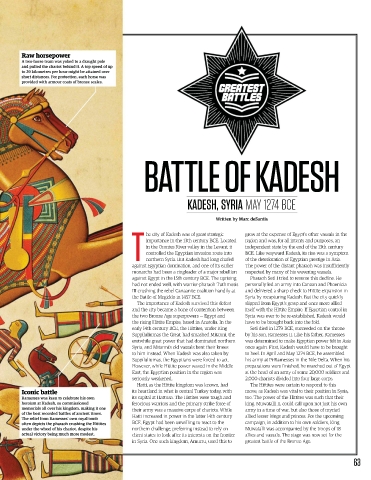
Raw horsepower
         A two-horse team was yoked to a draught pole
         and pulled the chariot behind it. A top speed of up
         to 29 kilometres per hour might be attained over
         short distances. For protection, each horse was
         provided with armour coats of bronze scales.


                                                    BATTLE OF KADESH


                                                                   KADESH, SYRIA MAY 1274 BCE


                                                                             Written by Marc deSantis

                                                    he city of Kadesh was of great strategic   grow at the expense of Egypt’s other vassals in the
                                                    importance in the 13th century BCE. Located   region and was, for all intents and purposes, an
                                                    in the Orontes River valley in the Levant, it   independent state by the end of the 13th century
                                                    controlled the Egyptian invasion route into   BCE. Like wayward Kadesh, its rise was a symptom
                                               T northern Syria. But Kadesh had long chafed   of the deterioration of Egyptian prestige in Asia.
                                               against Egyptian domination, and one of its earlier   The power of the distant pharaoh was insufficiently
                                               monarchs had been a ringleader of a major rebellion   respected by many of his wavering vassals.
                                               against Egypt in the 15th century BCE. The uprising   Pharaoh Seti I tried to reverse this decline. He
                                               had not ended well, with warrior-pharaoh Tuthmosis   personally led an army into Canaan and Phoenicia
                                               III crushing the rebel Canaanite coalition handily at   and delivered a sharp check to Hittite expansion in
                                               the Battle of Megiddo in 1457 BCE.      Syria by recapturing Kadesh. But the city quickly
                                                 The importance of Kadesh survived this defeat   slipped from Egypt’s grasp and once more allied
                                               and the city became a bone of contention between   itself with the Hittite Empire. If Egyptian control in
                                               the two Bronze Age superpowers — Egypt and   Syria was ever to be re-established, Kadesh would
                                               the rising Hittite Empire, based in Anatolia. In the   have to be brought back into the fold.
                                               early 14th century BCE, the Hittites, under King   Seti died in 1279 BCE, succeeded on the throne
                                               Suppiluliumas the Great, had smashed Mitanni, the   by his son, Ramesses II. Like his father, Ramesses
                                               erstwhile great power that had dominated northern   was determined to make Egyptian power felt in Asia
                                               Syria, and Mitanni’s old vassals bent their knees   once again. First, Kadesh would have to be brought
                                               to him instead. When Kadesh was also taken by   to heel. In April and May 1274 BCE, he assembled
                                               Suppiluliumas, the Egyptians were forced to act.   his army at Pi-Ramesses in the Nile Delta. When his
                                               However, while Hittite power waxed in the Middle   preparations were finished, he marched out of Egypt
                                               East, the Egyptian position in the region was   at the head of an army of some 20,000 soldiers and
                                               seriously weakened.                     2,000 chariots divided into four large corps.
                                                 Hatti, as the Hittite kingdom was known, had   The Hittites were certain to respond to this
                                               its heartland in what is central Turkey today, with   move, as Kadesh was vital to their position in Syria,
         Iconic battle
         Ramesses was keen to celebrate his own   its capital at Hattusa. The Hittites were tough and   too. The power of the Hittites was such that their
         heroism at Kadesh, so commissioned    ferocious warriors and the primary strike force of   king, Muwatalli II, could call upon not just his own
         memorials all over his kingdom, making it one   their army was a massive corps of chariots. While   army in a time of war, but also those of myriad
         of the best recorded battles of ancient times.
         The relief from Ramesses’ own royal tomb   Hatti increased in power in the latter 14th century   allied lesser kings and princes. For the upcoming
         often depicts the pharaoh crushing the Hittites   BCE, Egypt had been unwilling to react to the   campaign, in addition to his own soldiers, King
         under the wheel of his chariot, despite his   northern challenge, preferring instead to rely on   Muwatalli was accompanied by the troops of 18
         actual victory being much more modest.  client states to look after its interests on the frontier   allies and vassals. The stage was now set for the
                                               in Syria. One such kingdom, Amurru, used this to   greatest battle of the Bronze Age.


                                                                                                                             63

