


Page 70 - All About History - Issue 54-17
P. 70
Regency women


             Sojourner Truth


                        C. 1797 — 26 November 1883
                  This former slave went to court to free her child

              Sojourner Truth made history when she escaped slavery and
              discovered that her five-year-old son remained in chains. She had
              been sold at the age of nine for the price of $100 and a flock of
              sheep, and her life had been hard as she was passed around owners
              throughout New York.
                Following her daring escape from captivity, her life changed
              forever. In a groundbreaking legal case, Sojourner took the man who
              owned her child to court and won, becoming the first black woman
              to legally challenge a white man and emerge victorious.
                Sojourner was celebrated among abolitionists for her remarkable
              achievement and became a public speaker who was in high demand.
              Wherever she was due to lecture, she was a hot ticket. Her speeches
              were on slavery and suffrage and she became famed for her
              passionate speech Ain’t I A Woman, which was widely published
              across America.
                Sojourner wasn’t content with simply giving speeches, though,
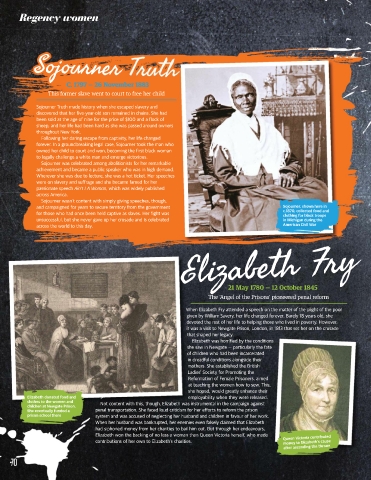
              and campaigned for years to secure territory from the government                       Sojourner, shown here in
                                                                                                     c.1870, collected food and
              for those who had once been held captive as slaves. Her fight was
                                                                                                     clothing for black troops
              unsuccessful, but she never gave up her crusade and is celebrated                      in Michigan during the
              across the world to this day.                                                          American Civil War
                                                                 Elizabeth Fry


                                                                                 21 May 1780 — 12 October 1845
                                                                          The ‘Angel of the Prisons’ pioneered penal reform

                                                                  When Elizabeth Fry attended a speech on the matter of the plight of the poor
                                                                  W
                                                                   g given by William Savery, her life changed forever. Barely 18 years old, she
                                                                   d devoted the rest of her life to helping those who lived in poverty. However,
                                                                   it was a visit to Newgate Prison, London, in 1813 that set her on the crusade
                                                                   it
                                                                   t that shaped her legacy.
                                                                    Elizabeth was horrified by the conditions
                                                                   s she saw in Newgate — particularly the fate
                                                                   o of children who had been incarcerated
                                                                   in dreadful conditions alongside their
                                                                   mothers. She established the British
                                                                   Ladies’ Society for Promoting the
                                                                   Reformation of Female Prisoners, aimed
                                                                   at teaching the women how to sew. This,
                                                                   she hoped, would greatly enhance their
           Elizabeth donated food and                              employability when they were released.
           clothes to the women and   Not content with this, though, Elizabeth was
                                    Not content with this, though, Elizabeth was instrumental in the campaign against
           children at Newgate Prison.
           She eventually funded a   penal transportation. She faced loud criticism for her efforts to reform the prison
           prison school there     system and was accused of neglecting her husband and children in favour of her work.
                                   When her husband was bankrupted, her enemies even falsely claimed that Elizabeth
                                   had siphoned money from her charities to bail him out. But through her endeavours,
                                   Elizabeth won the backing of no less a woman than Queen Victoria herself, who made   Queen Victoria contributed
                                   contributions of her own to Elizabeth’s charities.                money to Elizabeth’s cause
                                                                                                     after ascending the throne

     70

