


Page 72 - All About History - Issue 54-17
P. 72
Regency women


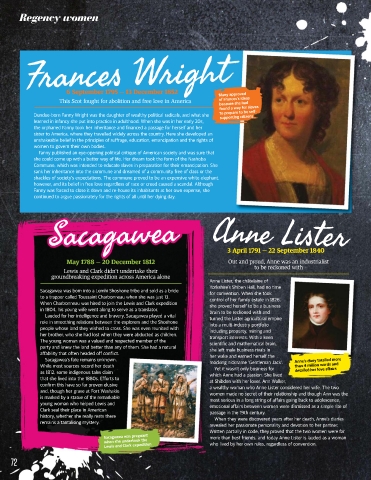
          Frances Wright


                        6 September 1795 — 13 December 1852                   Many approved
                      This Scot fought for abolition and free love in America  of Frances’s ideas
                                                                              because she had
                                                                              found a way for slaves
             Dundee-born Fanny Wright was the daughter of wealthy political radicals, and what she   to prepare to be self-
                                                                              supporting citizens
             learned in infancy she put into practice in adulthood. When she was in her early 20s,
             the orphaned Fanny took her inheritance and financed a passage for herself and her
             sister to America, where they travelled widely across the country. Here she developed an
             unshakeable belief in the principles of suffrage, education, emancipation and the rights of
             women to govern their own bodies.
               Fanny published an eye-opening political critique of American society and was sure that
             she could come up with a better way of life. Her dream took the form of the Nashoba
             Commune, which was intended to educate slaves in preparation for their emancipation. She
             sank her inheritance into the commune and dreamed of a community free of class or the
             shackles of society’s expectations. The commune proved to be an expensive white elephant,
             however, and its belief in free love regardless of race or creed caused a scandal. Although
             Fanny was forced to close it down and re-house its inhabitants at her own expense, she
             continued to argue passionately for the rights of all until her dying day.

                  Sacagawea                                                 Anne Lister


                                                                                 3 April 1791 — 22 September 1840

                        May 1788 — 20 December 1812                              Out and proud, Anne was an industrialist
                                                                                          to be reckoned with
                       Lewis and Clark didn’t undertake their
                   groundbreaking expedition across America alone
                                                                           Anne Lister, the châtelaine of
                                                                           Yorkshire’s Shiben Hall, had no time
               Sacagawea was born into a Lemhi Shoshone tribe and sold as a bride   for convention. When she took
               to a trapper called Toussaint Charbonneau when she was just 13.   control of her family estate in 1826,
               When Charbonneau was hired to join the Lewis and Clark expedition   she proved herself to be a business
               in 1804, his young wife went along to serve as a translator.  brain to be reckoned with and
                 Lauded for her intelligence and bravery, Sacagawea played a vital   turned the Lister agricultural empire
               role in smoothing relations between the explorers and the Shoshone   into a multi-industry portfolio
               people whose land they wished to cross. She was even reunited with   including property, mining and
               her brother, who she had lost when they were abducted as children.   transport interests. With a keen
               The young woman was a valued and respected member of the    scientific and mathematical brain,
               party and knew the land better than any of them. She had a natural   she left male business rivals in
               affability that often headed off conflict.                  her wake and earned herself the
                 Sacagawea’s fate remains unknown.                         mocking nickname ‘Gentleman Jack’.  Anne’s diary totalled more
               While most sources record her death                          Yet it wasn’t only business for   than 4 million words and
                                                                                                         detailed her love affairs
               as 1812, some indigenous tales claim                        which Anne had a passion. She lived
               that she lived into the 1880s. Efforts to                   at Shibden with her lover, Ann Walker,
               confirm this have so far proven elusive                     a wealthy woman who Anne Lister considered her wife. The two
               and, though her grave at Fort Washakie                      women made no secret of their relationship and though Ann was the
               is marked by a statue of the remarkable                     most serious in a long string of affairs going back to adolescence,
               young woman who helped Lewis and                            emotional affairs between women were dismissed as a simple rite of
               Clark seal their place in American                          passage in the 19th century.
               history, whether she really rests there                      When they were discovered years after her death, Anne’s diaries
               remains a tantalising mystery.
                                                                           revealed her passionate personality and devotion to her partner.
                                                                           Written partially in code, they proved that the two women were far
                                      Sacagawea was pregnant               more than best friends, and today Anne Lister is lauded as a woman
                                      when she undertook the
                                      Lewis and Clark expedition           who lived by her own rules, regardless of convention.

     72

