


Page 62 - Time Special Edition Alternative Medicine (January 2020)
P. 62
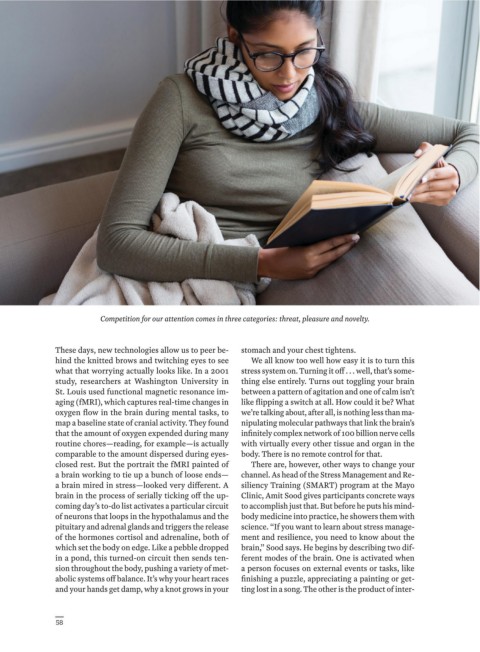
Competition for our attention comes in three categories: threat, pleasure and novelty.


                   These days, new technologies allow us to peer be-            stomach and your chest tightens.
                   hind the knitted brows and twitching eyes to see                We all know too well how easy it is to turn this
                   what that worrying actually looks like. In a 2001            stress system on. Turning it off . . . well, that’s some-
                   study,  researchers    at  Washington    University    in    thing else entirely. Turns out toggling your brain

                   St. Louis used functional magnetic resonance im-             between a pattern of agitation and one of calm isn’t
                   aging (fMRI), which captures real-time changes in            like flipping a switch at all. How could it be? What
                   oxygen flow in the brain during mental tasks, to             we’re talking about, after all, is nothing less than ma-
                   map a baseline state of cranial activity. They found         nipulating molecular pathways that link the brain’s
                   that the amount of oxygen expended during many               infinitely complex network of 100 billion nerve cells
                   routine chores—reading, for example—is actually              with virtually every other tissue and organ in the
                   comparable to the amount dispersed during eyes-              body. There is no remote control for that.
                   closed rest. But the portrait the fMRI painted of               There are, however, other ways to change your
                   a brain working to tie up a bunch of loose ends—             channel. As head of the Stress Management and Re-

                   a brain mired in stress—looked very different. A             siliency Training (SMART) program at the Mayo
                   brain in the process of serially ticking off the up-         Clinic, Amit Sood gives participants concrete ways
                   coming day’s to-do list activates a particular circuit       to accomplish just that. But before he puts his mind-
                   of neurons that loops in the hypothalamus and the            body medicine into practice, he showers them with
                   pituitary and adrenal glands and triggers the release        science. “If you want to learn about stress manage-
                   of the hormones cortisol and adrenaline, both of             ment and resilience, you need to know about the
                   which set the body on edge. Like a pebble dropped            brain,” Sood says. He begins by describing two dif-

                   in a pond, this turned-on circuit then sends ten-            ferent modes of the brain. One is activated when
                   sion throughout the body, pushing a variety of met-          a person focuses on external events or tasks, like
                   abolic systems off balance. It’s why your heart races        finishing a puzzle, appreciating a painting or get-
                   and your hands get damp, why a knot grows in your            ting lost in a song. The other is the product of inter-


                   58

