


Page 63 - Time Special Edition Alternative Medicine (January 2020)
P. 63
nalized thoughts: planning, thinking and worrying. ingrained in the way these networks are set up,”
Those internal ized thoughts are where trouble lies. Sood says.
Everything that competes for our attention, he The stress response was always meant to be an
explains, falls into one of three categories: threat, emergency measure only, a quick and focused re-
pleasure or novelty. And unfortunately, we have action to impending and immediate disaster. But
evolved to prioritize threat. That’s how early man modern-day threats—job security, your faltering
protected himself from mortal dangers like preda- 401(k), your daughter’s new boyfriend—tend to
tors, flood and fire. Today most of the threats we linger. And neither our brains nor our bodies were
encounter are of our own making, such as anxiety designed to manage that kind of sustained strain.
about upcoming engagements, guilt over things we So they protest. And that rebellion takes the form of
have done or said, and fears of the future. At first heart disease, hypertension, stroke and depression.
glance, those “threats” don’t seem to pack the men- Fortunately—and here is the point of Sood’s
ace of a hungry sabertooth cat. But they engulf our training—just as those well-worn negative neu-
attention like black holes all the same. And once we ral pathways can be created, they can also be re-
are sucked in, it’s extremely difficult to free our- directed. The key is learning to recognize what it
selves from the gravitational pull. feels like when you begin to slip into the default
Making escape even more sticky is the fact that a state. Only then can you work on breaking free of
stressful state often becomes the brain’s default set- its grasp. Eventually what once took conscious effort
ting, one it slips into almost automatically. Blame to adjust becomes another ingrained circuit—and
human biology. The plasticity of the brain allows its the new default. “It’s more a life skill than anything
frequently used nerves and networks to become well else,” says Sood. Rebuilding that mental infrastruc-
worn, like a rutted country road, and your thoughts ture means being able to focus on the task or expe-
end up stuck following routes that take them some- rience at hand, shutting yourself off from any other
where other than where you want them to go. Soon, distracting thoughts. It’s what meditation experts
obsessing over perceived threats is your norm; you are advocating when they talk about “emptying the
go to bed with your head spinning with them and mind” or “being in the moment,” and it’s what they
wake up still churning. “This is nobody’s fault; it’s hope to accomplish when they ask clients to con-
centrate on their breathing. Of course, the more in-
grained the stress pathway, the more difficult this
seemingly uncomplicated task can be.
Sood says you just have to train your brain one
thought at a time. Be more attentive to external
rather than internal experiences. Start with those
very first thoughts of the morning: Don’t be en-
snared by responsibilities; welcome the day in-
stead by thinking about five individuals you love.
Picturing their faces one at a time, remind yourself
why you are grateful and happy to have them in your
life. Then, throughout the day, find reasons to take
10-minute breaks to draw yourself away from your
pressure-filled routines. When you’re with friends
or family members, treat them as if you are meeting
after a long time apart; pay attention to what they
say and how they are feeling. Sometimes a change
of scenery helps, so take a walk. Make sure it’s not a
march to the finish, though, consumed all the while
by the chaos in your head. The purpose of getting
away is to get away.
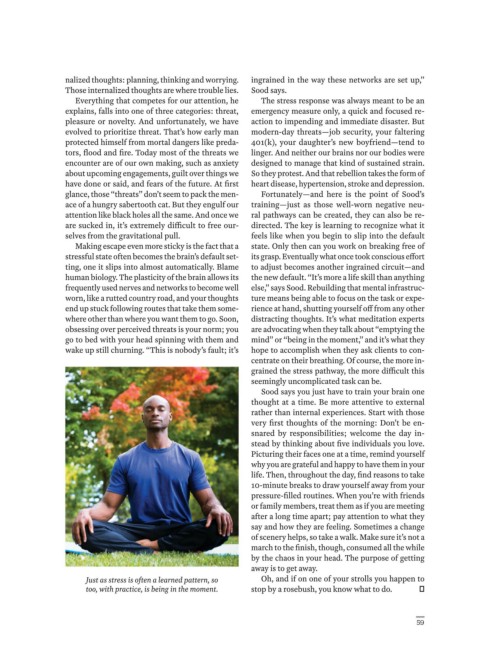
Just as stress is often a learned pattern, so Oh, and if on one of your strolls you happen to
too, with practice, is being in the moment. stop by a rosebush, you know what to do.
59

