


Page 69 - Time Special Edition Alternative Medicine (January 2020)
P. 69
says renowned evolutionary biologist Robert Triv- with some concern. “This is the paradox,” says Bene-
ers, author of The Folly of Fools: The Logic of Deceit detti. “The more we change the meaning of placebo
and Self-Deception in Human Life. “On average, we from negative to positive, the more quacks and sha-
are susceptible to placebos; that doesn’t mean we mans feel justified in using new bizarre ways to in-
all are, and it definitely doesn’t mean we all exhibit crease expectations.” Yet it’s not just the charlatans
that trait uniformly,” says Trivers. There are prob- who complicate matters. Call it the ethics of decep-
ably many factors, including genetic ones, at play. tion. Most doctors still believe, and rightly so, that
But the bottom line is that there is no simple way to it’s just not right to tell a patient he is getting a drug
determine who will respond and who won’t. when he isn’t. Of course, that pa tient could be told
Being able to accurately measure placebo effects he is getting “treatment that has been shown to be
is just as important as knowing who will respond. effective in many cases,” and that would be true.
But that, too, is easier said than done. In the 1950s, But what if patients are told the whole truth? Ted
when researchers first began to use placebos in stan- Kaptchuk, who directs placebo studies at Harvard
dardized trials, they knew that participants in the Medical School, has demonstrated in clinical trials
placebo group were likely to improve (healers have that placebos can, in fact, work even when patients
always had an intuitive sense of the power of pla- know they are getting them. It’s an intriguing find-
cebos), and that was OK; the group’s improvement ing, but in the real world of medical care, issues of
was the bar the experimental therapy had to clear to informed consent are trickier.
be deemed worthy. It is a standard that has served For her part, ER physician Campbell wants to
medicine well and is now, in fact, being used to equal make sure one very important lesson isn’t lost. “Pla-
effect to evaluate the latest complementary thera- cebo research highlights the importance of an aspect
pies. But serving passively as the control group in of medicine that is disappearing: the value of the
trials is no longer enough. If researchers are going face-to-face human interaction between the doctor
to be able to tap the full potential of this approach, and the patient,” she says. Placebos remind us that
they need to know not only how placebos stack up what matters is not just the active ingredients in a
against active treatment but also how they compare pill. Attention is treatment too.
with no treatment at all. Who would have thought that the art of healing
Placebo research has a long way to go. And con- would one day be supported by the science of pla-
fusing the issue is the fact that every advance comes cebo effects?
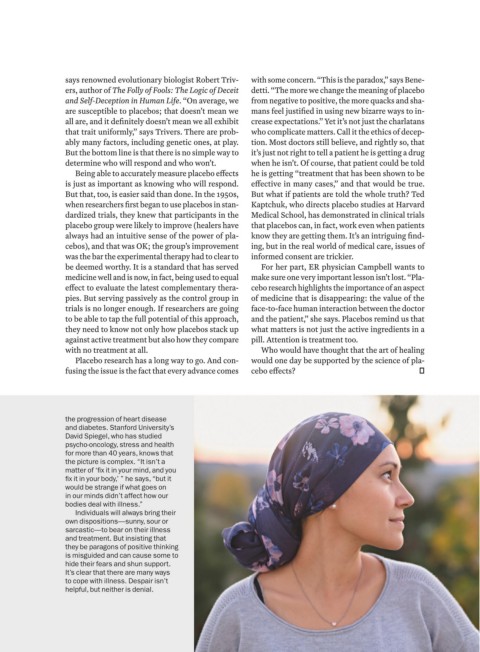
the progression of heart disease
and diabetes. Stanford University’s
David Spiegel, who has studied
psycho-oncology, stress and health
for more than 40 years, knows that
the picture is complex. “It isn’t a
matter of ‘fix it in your mind, and you
fix it in your body,’ ” he says, “but it
would be strange if what goes on
in our minds didn’t affect how our
bodies deal with illness.”
Individuals will always bring their
own dispositions—sunny, sour or
sarcastic—to bear on their illness
and treatment. But insisting that
they be paragons of positive thinking
is misguided and can cause some to
hide their fears and shun support.
It’s clear that there are many ways
to cope with illness. Despair isn’t
helpful, but neither is denial.

