


Page 68 - Time Special Edition Alternative Medicine (January 2020)
P. 68
ALTERNATIVE      MEDICINE MINDS MATTER


                   immunosuppression drugs that lower the rejection
                   rate in organ-transplant patients, as well as relieve
                   cold symptoms and allergic skin reactions.
                      This type of conditioning is mostly unconscious:
                   we don’t have to will our bodies to think of saline
                   as morphine. But we are also quick studies. What
                   would a caveman make of the assortment of pills
                   in our medicine cabinets? Absolutely nothing. But

                   we have come to expect certain types of relief from
                   medicines    of  particular  shapes,  sizes  and  colors.
                   We also expect a certain expertise and competence
                   when we see high-tech equipment, white lab coats
                   and diplomas on the wall. Doctors know what they
                   are doing, but it also helps that we believe they know
                   what they are doing.

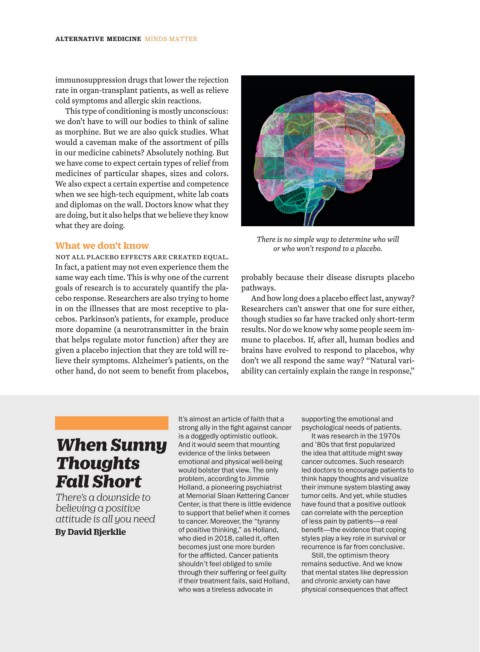
                                                                                     There is no simple way to determine who will
                   What we don’t know                                                      or who won’t respond to a placebo.
                   not all placebo effects are created equal.
                   In fact, a patient may not even experience them the
                   same way each time. This is why one of the current           probably   because   their  disease  disrupts   placebo
                   goals of research is to accurately quantify the pla-         pathways.
                   cebo response. Researchers are also trying to home              And how long does a placebo effect last, anyway?
                   in on the illnesses that are most receptive to pla-          Researchers can’t answer that one for sure either,
                   cebos. Parkinson’s patients, for example, produce            though studies so far have tracked only short-term

                   more dopamine (a neurotransmitter in the brain               results. Nor do we know why some people seem im-
                   that helps regulate motor function) after they are           mune to placebos. If, after all, human bodies and
                   given a placebo injection that they are told will re-        brains have evolved to respond to placebos, why
                   lieve their symptoms. Alzheimer’s patients, on the           don’t we all respond the same way? “Natural vari-
                   other hand, do not seem to benefit from placebos,            ability can certainly explain the range in response,”


                                                           It’s almost an article of faith that a   supporting the emotional and
                                                           strong ally in the fight against cancer   psychological needs of patients.
                                                           is a doggedly optimistic outlook.           It was research in the 1970s
                   When Sunny                              And it would seem that mounting          and ’80s that first popularized
                                                           evidence of the links between            the idea that attitude might sway
                   Thoughts                                emotional and physical well-being        cancer outcomes. Such research
                                                           would bolster that view. The only        led doctors to encourage patients to
                   Fall Short                              problem, according to Jimmie             think happy thoughts and visualize
                                                           Holland, a pioneering psychiatrist
                                                                                                    their immune system blasting away
                   There’s a downside to                   at Memorial Sloan Kettering Cancer       tumor cells. And yet, while studies
                   believing a positive                    Center, is that there is little evidence   have found that a positive outlook
                                                           to support that belief when it comes     can correlate with the perception
                   attitude is all you need                to cancer. Moreover, the “tyranny        of less pain by patients—a real
                   By David Bjerklie                       of positive thinking,” as Holland,       benefit—the evidence that coping
                                                           who died in 2018, called it, often       styles play a key role in survival or
                                                           becomes just one more burden             recurrence is far from conclusive.
                                                           for the afflicted. Cancer patients          Still, the optimism theory
                                                           shouldn’t feel obliged to smile          remains seductive. And we know
                                                           through their suffering or feel guilty   that mental states like depression
                                                           if their treatment fails, said Holland,   and chronic anxiety can have
                                                           who was a tireless advocate in           physical consequences that affect

