


Page 87 - Time Special Edition Alternative Medicine (January 2020)
P. 87
University Friedman School of Nu-
                                                                                                    trition Science and Policy. “For the
                                                                                                    general population, there’s no need
                                                                                                    to take dietary supplements.”
                                                                                                       Doctors also know that we eat not
                                                                                                    only to feed our cells but also because
                                                                                                    of emotions, such as feeling happy or
                                                                                                    sad. “It’s a lot cheaper to put some-

                                                                                                    one on three months of statins [to
                                                                                                    lower their cholesterol] than to fig-
                                                                                                    ure  out  how   to  get  them  to  eat  a
                                                                                                    healthy diet,” says Eric Rimm, a pro-
                                                                                                    fessor of epidemiology and nutrition
                                                                                                    at the Harvard T.H. Chan School of
                                                                                                    Public Health. But drugs are expen-

                                                                                                    sive—the average American spends
                                                                                                    $1,400 a year on medications—and
                                                                                                    if people can’t afford them, they go
                                                                                                    without,   increasing   the  likelihood
                                                                                                    that  they’ll  develop  complications
                                                                                                    as they progress to severe stages of
                                                                                                    their  illness,  which  in  turn  forces
                                                                                                    them to require more—and costly—
                                                                                                    health care. What’s more, it’s not as if

                                                                                                    the medications are cure-alls; while
                                                                                                    deaths from heart disease are declin-
                                                                                                    ing, for example, the most recent re-
                                                                                                    port from the American Heart Asso-
                                                                                                    ciation showed that the prevalence
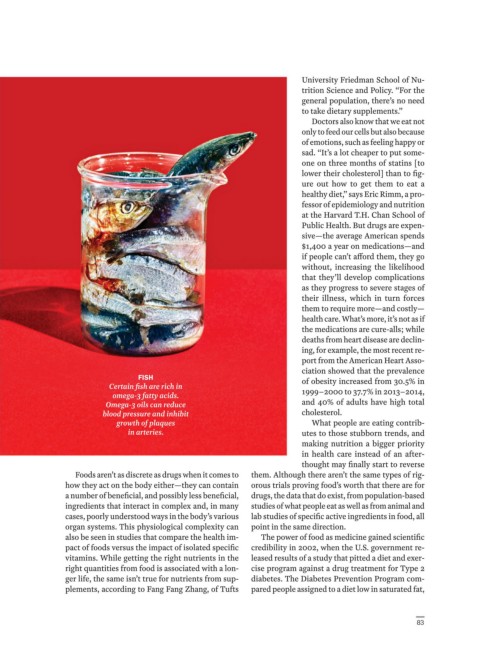
                                              FISH                                                  of obesity increased from 30.5% in
                                     Certain fish are rich in
                                      omega-3 fatty acids.                                          1999–2000 to 37.7% in 2013–2014,
                                    Omega-3 oils can reduce                                         and  40%   of  adults  have  high  total
                                   blood pressure and inhibit                                       cholesterol.
                                       growth of plaques                                               What people are eating contrib-
                                           in arteries.                                             utes to those stubborn trends, and
                                                                                                    making   nutrition   a  bigger  priority
                                                                                                    in  health  care  instead  of  an  after-
                                                                                                    thought may finally start to reverse
                          Foods aren’t as discrete as drugs when it comes to       them. Although there aren’t the same types of rig-

                      how they act on the body either—they can contain             orous trials proving food’s worth that there are for
                      a number of beneficial, and possibly less beneficial,        drugs, the data that do exist, from population-based
                      ingredients that interact in complex and, in many            studies of what people eat as well as from animal and
                      cases, poorly understood ways in the body’s various          lab studies of specific active ingredients in food, all
                      organ systems. This physiological complexity can             point in the same direction.
                      also be seen in studies that compare the health im-              The power of food as medicine gained scientific
                      pact of foods versus the impact of isolated specific         credibility in 2002, when the U.S. government re-

                      vitamins. While getting the right nutrients in the           leased results of a study that pitted a diet and exer-
                      right quantities from food is associated with a lon-         cise program against a drug treatment for Type 2
                      ger life, the same isn’t true for nutrients from sup-        diabetes. The Diabetes Prevention Program com-
                      plements, according to Fang Fang Zhang, of Tufts             pared people assigned to a diet low in saturated fat,


                                                                                                                                          83

