


Page 141 - (DK) Help Your Kids with Language Arts
P. 141
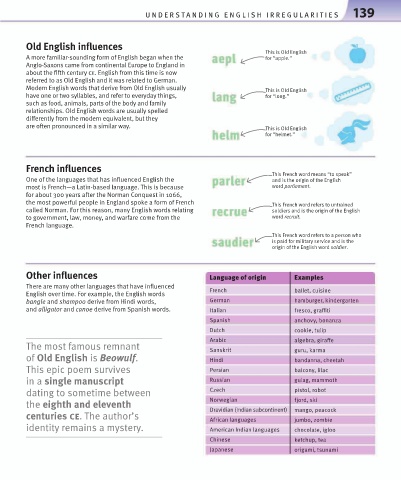
139
                                         UNDERS T ANDING ENGLISH IRRE GULARITIE S


        Old English influences
                                                                          This is Old English
        A more familiar-sounding form of English began when the           for “apple.”
        Anglo-Saxons came from continental Europe to England in
        about the fifth century ce. English from this time is now
        referred to as Old English and it was related to German.
        Modern English words that derive from Old English usually         This is Old English
        have one or two syllables, and refer to everyday things,          for “long.”
        such as food, animals, parts of the body and family
        relationships. Old English words are usually spelled
        differently from the modern equivalent, but they
        are often pronounced in a similar way.                            This is Old English
                                                                          for “helmet.”


        French influences
                                                                            This French word means “to speak”
        One of the languages that has influenced English the                 and is the origin of the English
        most is French—a Latin-based language. This is because              word parliament.
        for about 300 years after the Norman Conquest in 1066,
        the most powerful people in England spoke a form of French          This French word refers to untrained
        called Norman. For this reason, many English words relating         soldiers and is the origin of the English
        to government, law, money, and warfare come from the                word recruit.
        French language.
                                                                            This French word refers to a person who
                                                                            is paid for military service and is the
                                                                            origin of the English word soldier.


        Other influences                                    Language of origin     Examples
        There are many other languages that have influenced   French               ballet, cuisine
        English over time. For example, the English words
        bangle and shampoo derive from Hindi words,        German                 hamburger, kindergarten
        and alligator and canoe derive from Spanish words.  Italian               fresco, graffiti
                                                           Spanish                anchovy, bonanza
                                                           Dutch                  cookie, tulip
                                                           Arabic                 algebra, giraffe
        The most famous remnant                            Sanskrit               guru, karma
        of Old English is Beowulf.                         Hindi                  bandanna, cheetah
        This epic poem survives                            Persian                balcony, lilac
        in a single manuscript                             Russian                gulag, mammoth
        dating to sometime between                         Czech                  pistol, robot
                                                           Norwegian              fjord, ski
        the eighth and eleventh
                                                           Dravidian (Indian subcontinent)  mango, peacock
        centuries ce. The author’s                         African languages      jumbo, zombie
        identity remains a mystery.                        American Indian languages  chocolate, igloo
                                                           Chinese                ketchup, tea
                                                           Japanese               origami, tsunami

