


Page 142 - (DK) Help Your Kids with Language Arts
P. 142
140 SPELLING
Roots SEE ALSO
136–137 Morphemes
138–139 Understanding
THE ROOT IS THE PART OF A WORD THAT CONTAINS English irregularities
MEANING, EVEN WITHOUT A PREFIX OR SUFFIX. Prefixes and suffixes 142–143
A root can be an existing English word or part of a word,
and it usually originates from Latin or Greek. Learning to
identify roots can help with spelling and building vocabulary.
Whole root words
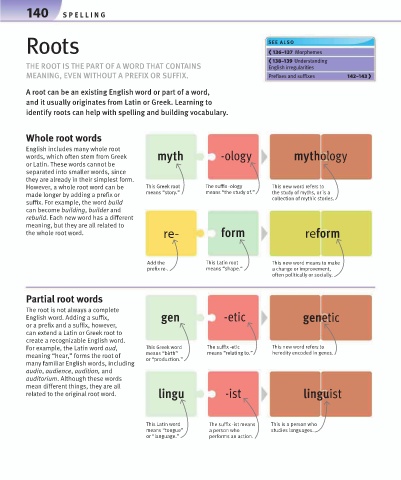
English includes many whole root
words, which often stem from Greek myth -ology mythology
or Latin. These words cannot be
separated into smaller words, since
they are already in their simplest form.
However, a whole root word can be This Greek root The suffix -ology This new word refers to
made longer by adding a prefix or means “story.” means “the study of.” the study of myths, or is a
collection of mythic stories.
suffix. For example, the word build
can become building, builder and
rebuild. Each new word has a different
meaning, but they are all related to
the whole root word. re- form reform
Add the This Latin root This new word means to make
prefix re-. means “shape.” a change or improvement,
often politically or socially.
Partial root words
The root is not always a complete
English word. Adding a suffix, gen -etic genetic
or a prefix and a suffix, however,
can extend a Latin or Greek root to
create a recognizable English word.
For example, the Latin word aud, This Greek word The suffix -etic This new word refers to
means “birth” means “relating to.” heredity encoded in genes.
meaning “hear,” forms the root of or “production.”
many familiar English words, including
audio, audience, audition, and
auditorium. Although these words
mean different things, they are all
related to the original root word. lingu -ist linguist
This Latin word The suffix -ist means This is a person who
means “tongue” a person who studies languages.
or “language.” performs an action.

