


Page 154 - (DK) Help Your Kids with Language Arts
P. 154
152 SPELLING
Words ending in -le, SEE ALSO
22–23 Nouns
-el, -al, or -ol 26–27 Adjectives
38–39 Verbs
136–137 Morphemes
THESE WORD ENDINGS ARE NOT USUALLY SUFFIXES. 140–141 Roots
142–143 Prefixes and suffixes
Similar-sounding word endings like -le, -el, -al, and -ol can cause
spelling difficulties. However, there are some guidelines that can
help with using them. As with all tricky spellings, a dictionary is
a valuable checking tool.
Words ending in -le Some other common words that end
The most common of these word endings is -le. This word with -ol use oo to create a long vowel
ending is not a suffix because it does not change the
meaning or part of speech of a root word. The -le word sound, as in the words cool, pool,
ending is usually found in nouns (such as table), verbs school, and tool.
(such as tickle), and adjectives (such as vile).
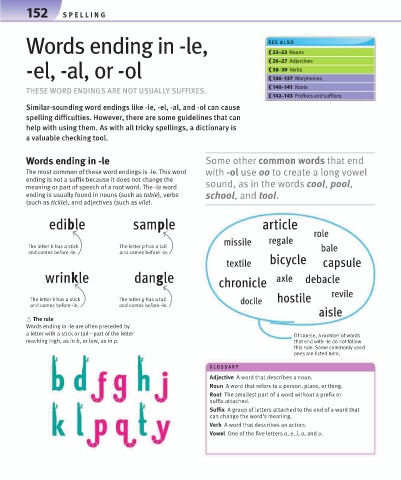
edible sample article
role
missile regale
The letter b has a stick The letter p has a tail bale
and comes before -le. and comes before -le.
textile bicycle capsule
wrinkle dangle chronicle axle debacle
The letter k has a stick The letter g has a tail docile hostile revile
and comes before -le. and comes before -le.
aisle
△ The rule
Words ending in -le are often preceded by
a letter with a stick or tail—part of the letter Of course, a number of words
reaching high, as in b, or low, as in p. that end with -le do not follow
this rule. Some commonly used
ones are listed here.
GLO S S A RY
Adjective A word that describes a noun.
Noun A word that refers to a person, place, or thing.
Root The smallest part of a word without a prefix or
suffix attached.
Suffix A group of letters attached to the end of a word that
can change the word’s meaning.
Verb A word that describes an action.
Vowel One of the five letters a, e, i, o, and u.

