


Page 158 - (DK) Help Your Kids with Language Arts
P. 158
156 SPELLING
The “i before e except SEE ALSO
130–131 Vowel sounds
138–139 Understanding English
after c” rule irregularities 164–165
Irregular word spellings
THE “I BEFORE E EXCEPT AFTER C” RULE IS USED
TO REMEMBER SPELLINGS CONTAINING IE OR EI.
• There are no cein words in
This rule has been used for more than 150 years, and the English language. If a c is
it works in the majority of cases. There are, however, followed by an ie/ei combination
then an n, the spelling should
many exceptions to the rule, and it’s best to learn
always be ie, as in science.
these and to be aware of them.
The rhyme
A useful rhyme was created to help The start of the rhyme means that
people remember the “i before e” i usually comes before e in words that
rule. Originally, it consisted of only contain an “ee” sound, such as thief.
two lines, but it has been expanded
over the years to include some
exceptions to the rule.
The e also goes first
I before e, when the sound
in the word is “ay,”
Except after c as in eight.
When the sound is “ee”
Or when sounded as “ay,”
However, when the “ee” As in neighbor and weigh,
sound comes after the
letter c, the e goes before But leisure and seize
the i, as in receive.
Do as they please.
REAL W OR L D
Loan words The end of the rhyme
notes that there are some
words that don’t follow
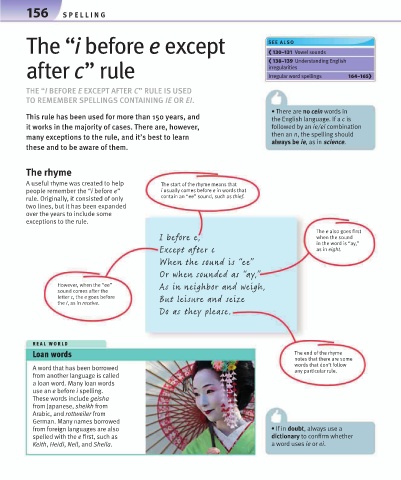
A word that has been borrowed any particular rule.
from another language is called
a loan word. Many loan words
use an e before i spelling.
These words include geisha
from Japanese, sheikh from
Arabic, and rottweiler from
German. Many names borrowed
from foreign languages are also • If in doubt, always use a
spelled with the e first, such as dictionary to confirm whether
Keith, Heidi, Neil, and Sheila. a word uses ie or ei.

